YTC LogoYTC Logo
Cases
AI Assistant for Private Equity Investment Platform

AI Assistant for Private Equity Investment Platform

AI Assistant  for Private Equity Investment Platform

A private equity platform in the USA needed a smarter way to access CRM knowledge across deals, companies, documents, and investment context. We built a CRM-native AI assistant that helps teams retrieve information faster, compare opportunities, and analyze pipeline activity more efficiently within one system.

Industry

FinTech

Client

Under NDA

Region

USA

Main challenges

Business Challenge: No unified access slowed investment analysis

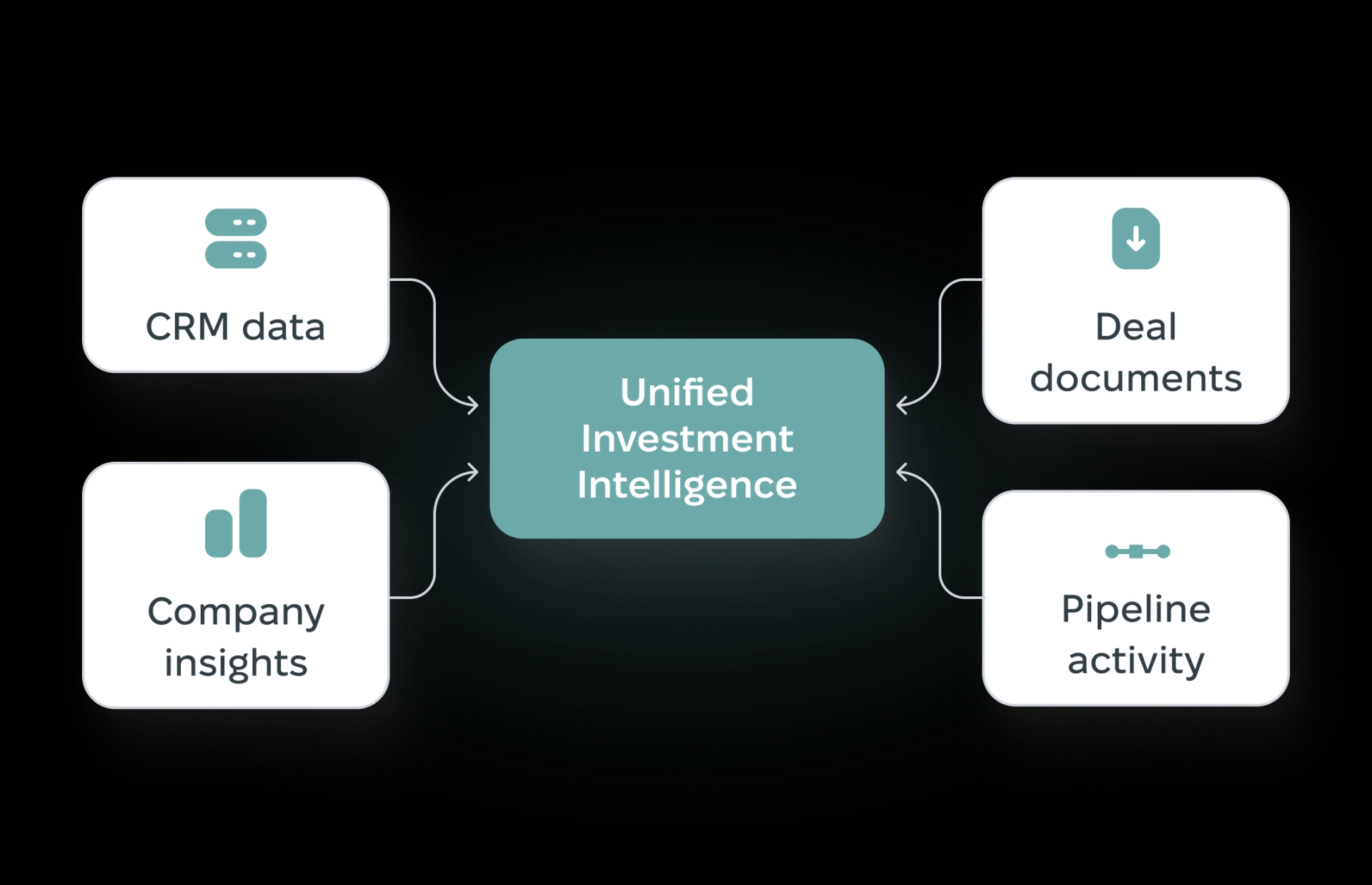
Investment teams lacked a unified way to review CRM knowledge across deals, companies, and documents.
  • Manual lookup slowed the pipeline and deal analysis
  • Teams spent time gathering scattered investment context
  • Opportunity comparison required extra CRM navigation
Illustration of unified access to private equity CRM data across deals, companies, documents, and pipeline stages

Technical Challenge: CRM data needed to become AI-ready

The assistant had to understand CRM entities, relationships, and context well enough to retrieve relevant answers reliably.
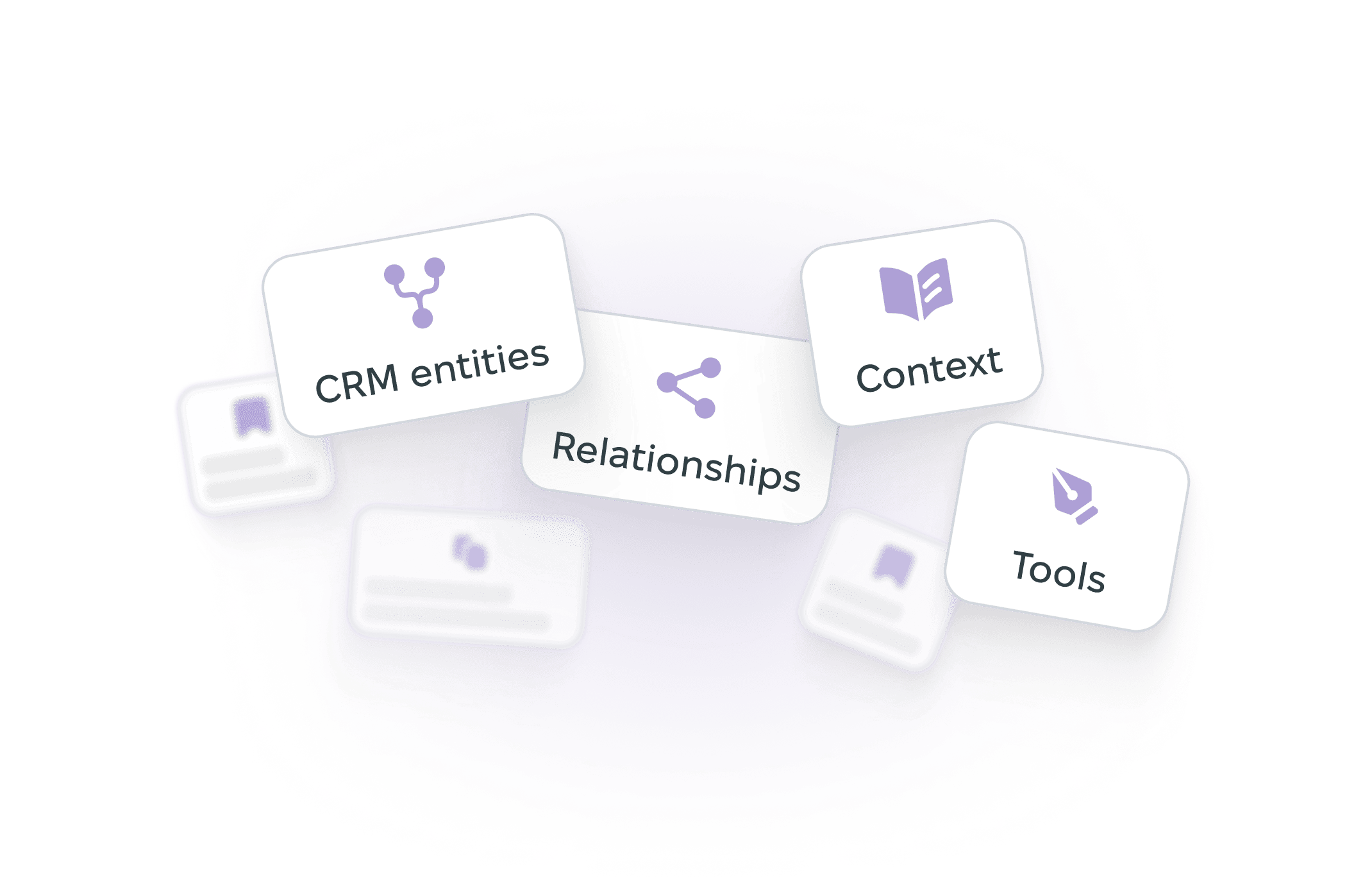
  • CRM entities required a structured, context-aware interpretation
  • Standard search could not deliver reliable answers
  • Tool routing had to work across entities
Structured CRM entities, relationships, and context layers prepared for reliable AI answers in an investment workflow

Delivery Challenge: Integrating AI across all CRM entities and workflows

The assistant had to work across core CRM entities, relationships, and workflows — not just surface-level retrieval.
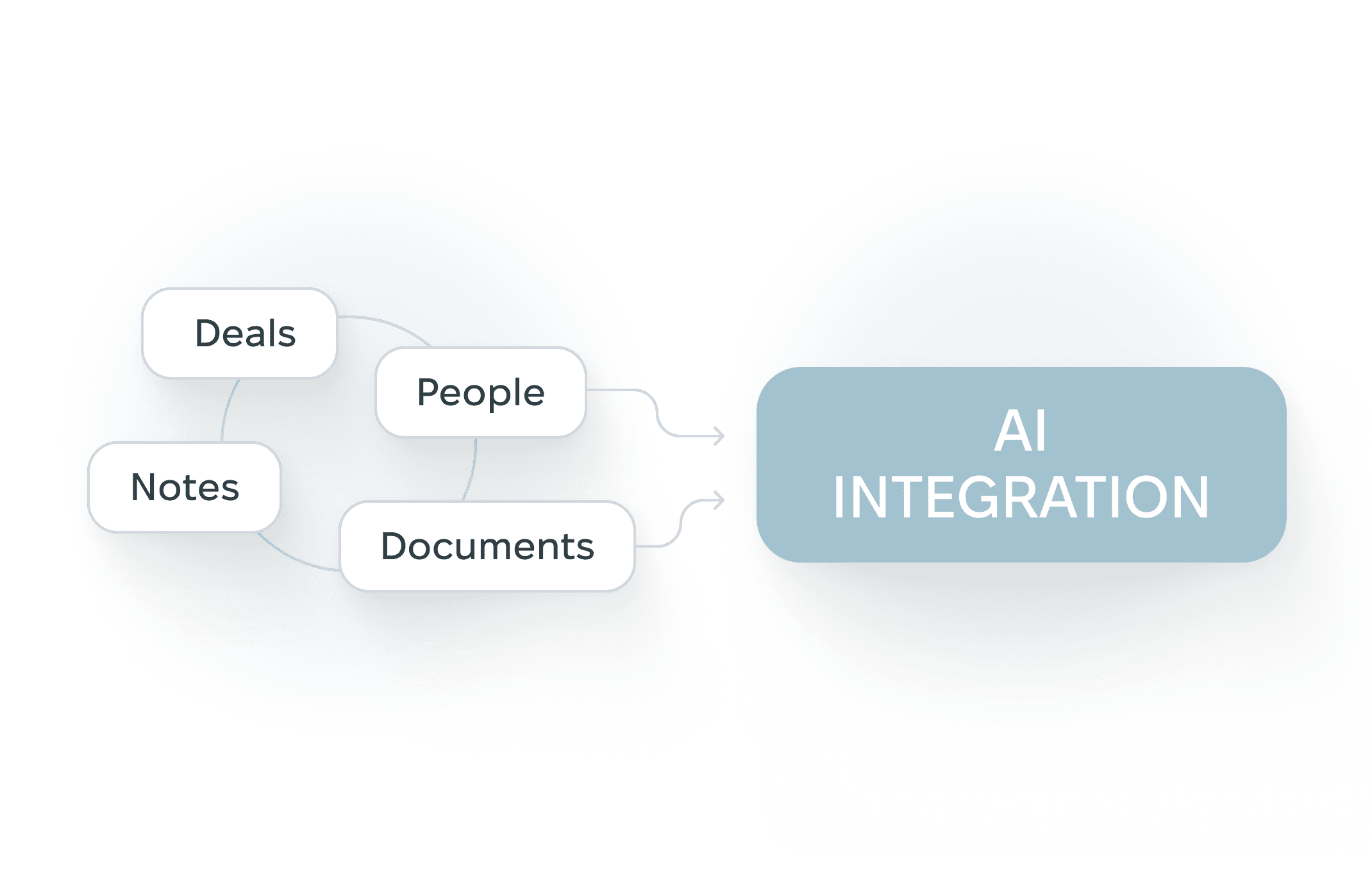
  • Scope covered all CRM entities: deals, companies, people, documents, notes, meetings etc
  • Tool-calling logic had to be built across key CRM entity types
  • An evaluation infrastructure was needed to maintain quality across releases
Flow from core PE CRM objects such as deals, people, notes, and documents into the integrated AI assistant layer

What we did

We developed a CRM-native AI assistant for a private equity investment platform to help teams access and analyze investment context faster. The assistant was designed to work across key CRM entities - including deals, companies, documents, meetings, IC decisions, people, and notes - through one unified interface.

To make the solution reliable in real workflows, we built it on a custom agent-based architecture using RAG, LLMs, and tool-calling. We also created a dedicated evaluation module with a golden dataset, LLM-as-a-Judge scoring, and algorithmic metrics to measure answer quality and support continuous improvement across releases.

200+

Expected-answer checks for release validation

12

Core CRM entities available through one assistant

2

LLMs in the evaluation workflow — one answers, one evaluates

1

Unified interface across core CRM knowledge

CRM-Native Agent Architecture

A custom agent framework built from scratch to support the full depth of private equity CRM workflows.
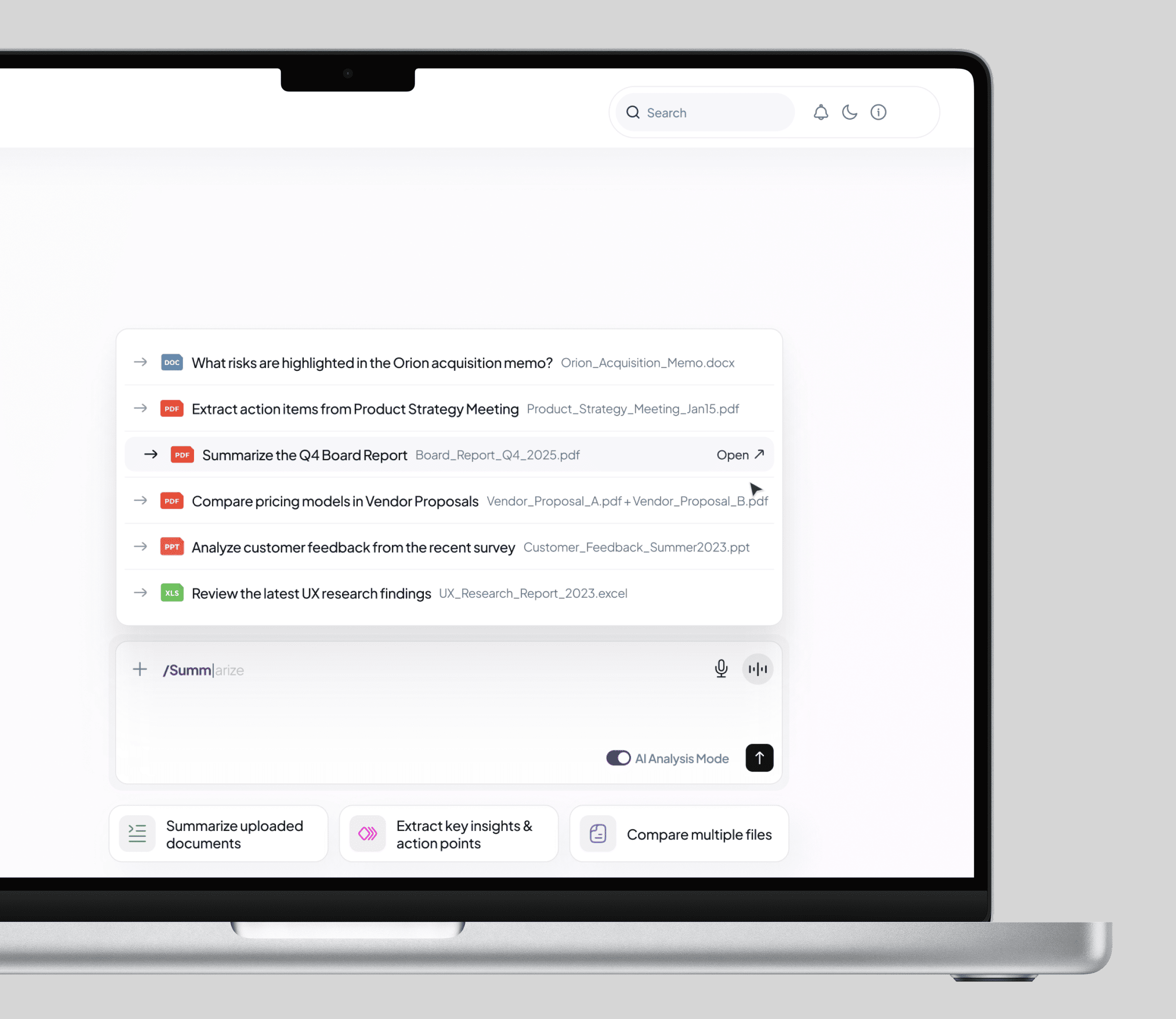
  • Understand CRM entities, relationships, and tool logic across key workflows
  • Extracts key financial metrics automatically
  • Structures data for direct CRM usage
Laptop showing a private equity CRM with an AI agent panel answering deal and pipeline questions from live CRM data

Multi-Model RAG + LLM Stack

An AI strategy built on RAG, LLMs, and a multi-model approach to deliver accurate answers across all investment data.
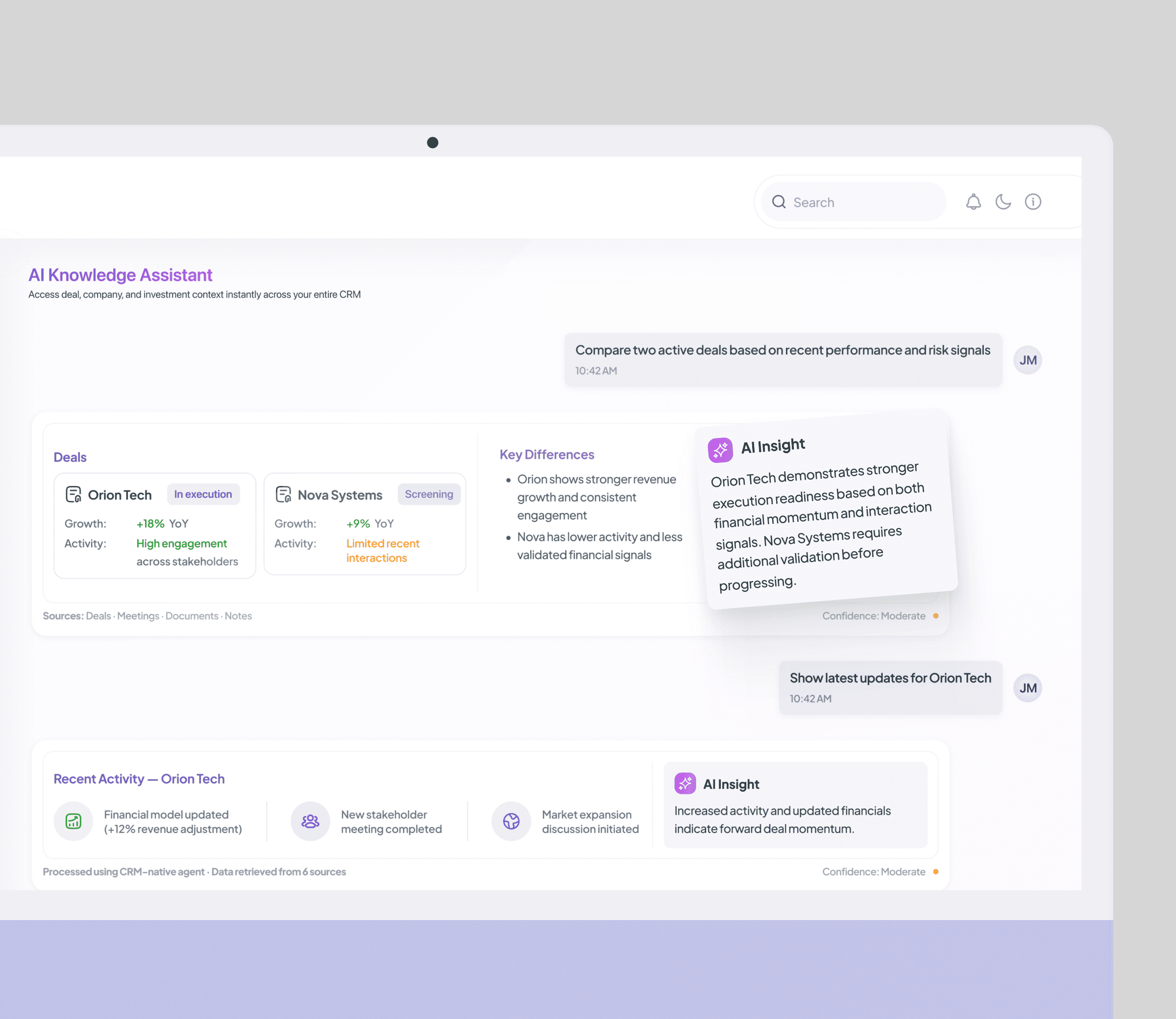
  • RAG retrieval across deals, investment memos, companies, and markets
  • Multi-model approach adapted to different query types
  • Covers companies, documents, IC decisions, meetings, and notes
  • Enables instant comparative analysis across portfolio companies
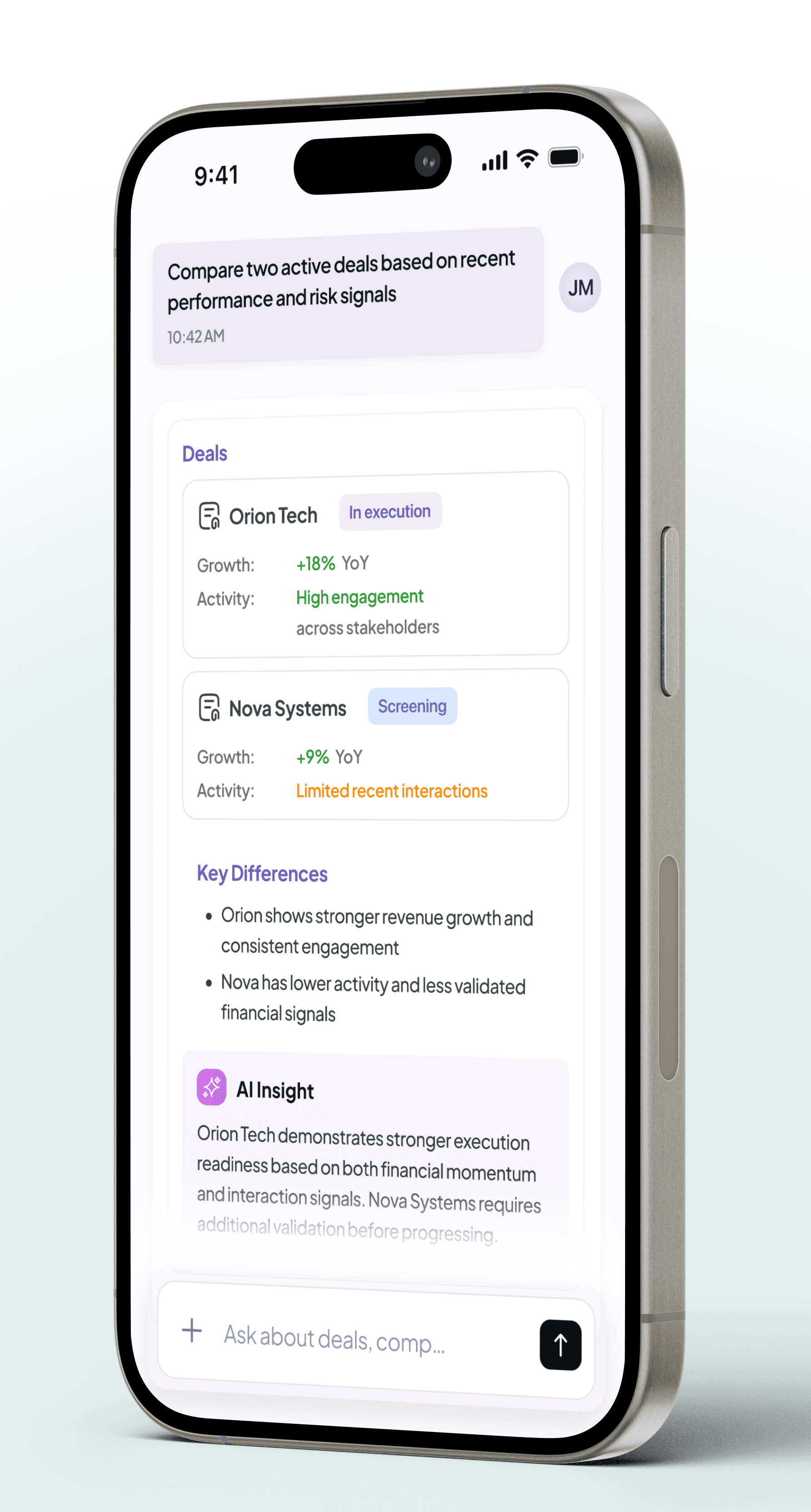
Assistant UI comparing two active deals with performance and risk signals plus sourced CRM and document context

Evaluation Module and Golden Dataset

A dedicated evaluation system built alongside the product to measure and improve output quality.
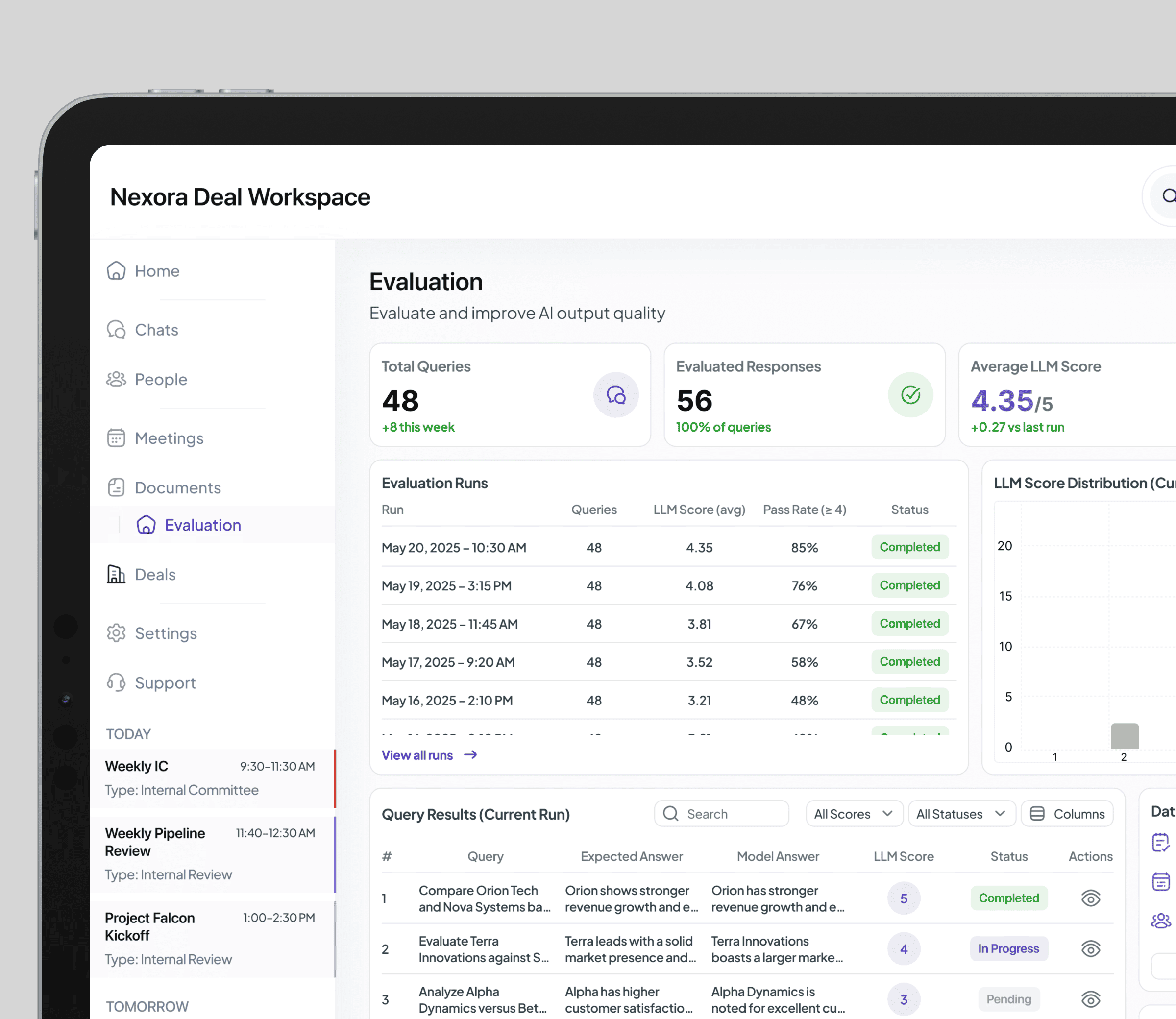
  • Organization built for controlled testing
  • 40+ queries with expected answers — ground truth baseline
  • LLM-as-a-Judge scores every response on a defined scale
  • Algorithmic metrics track output quality across releases
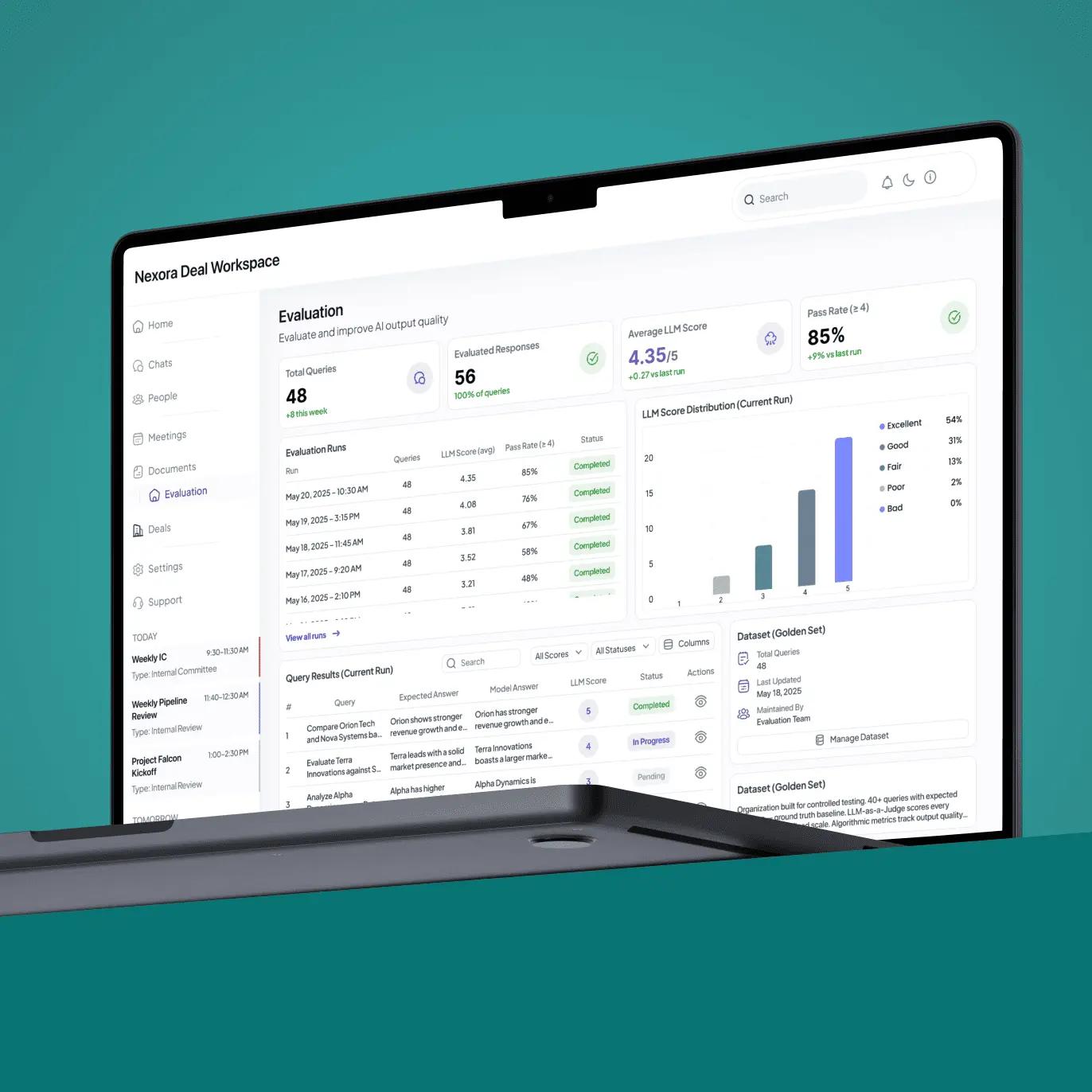
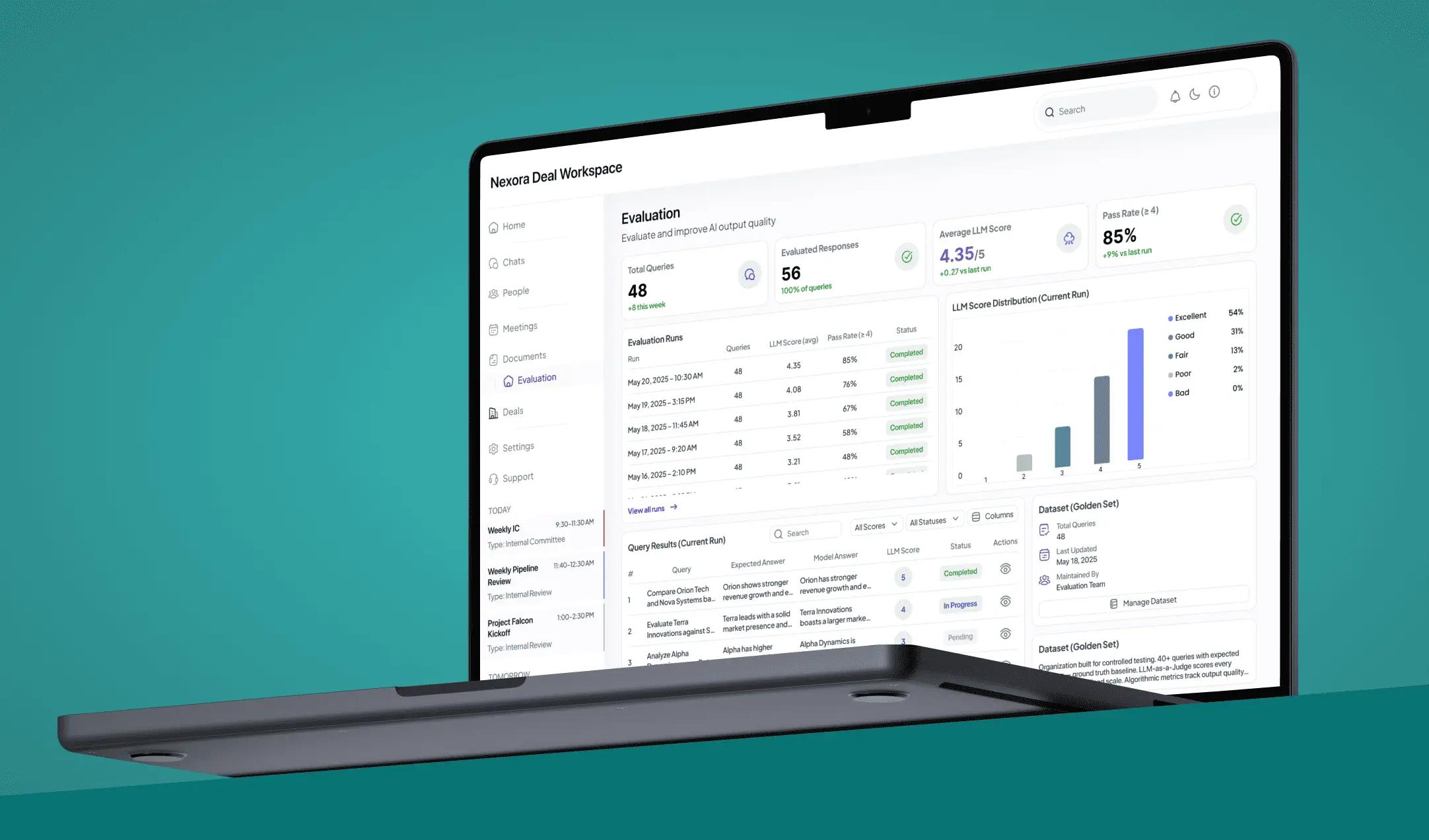
Golden-dataset evaluation dashboard with query counts, LLM-as-a-Judge scores, and historical evaluation runs

Continuous Quality Control

A two-LLM evaluation setup is used to assess response quality before release.
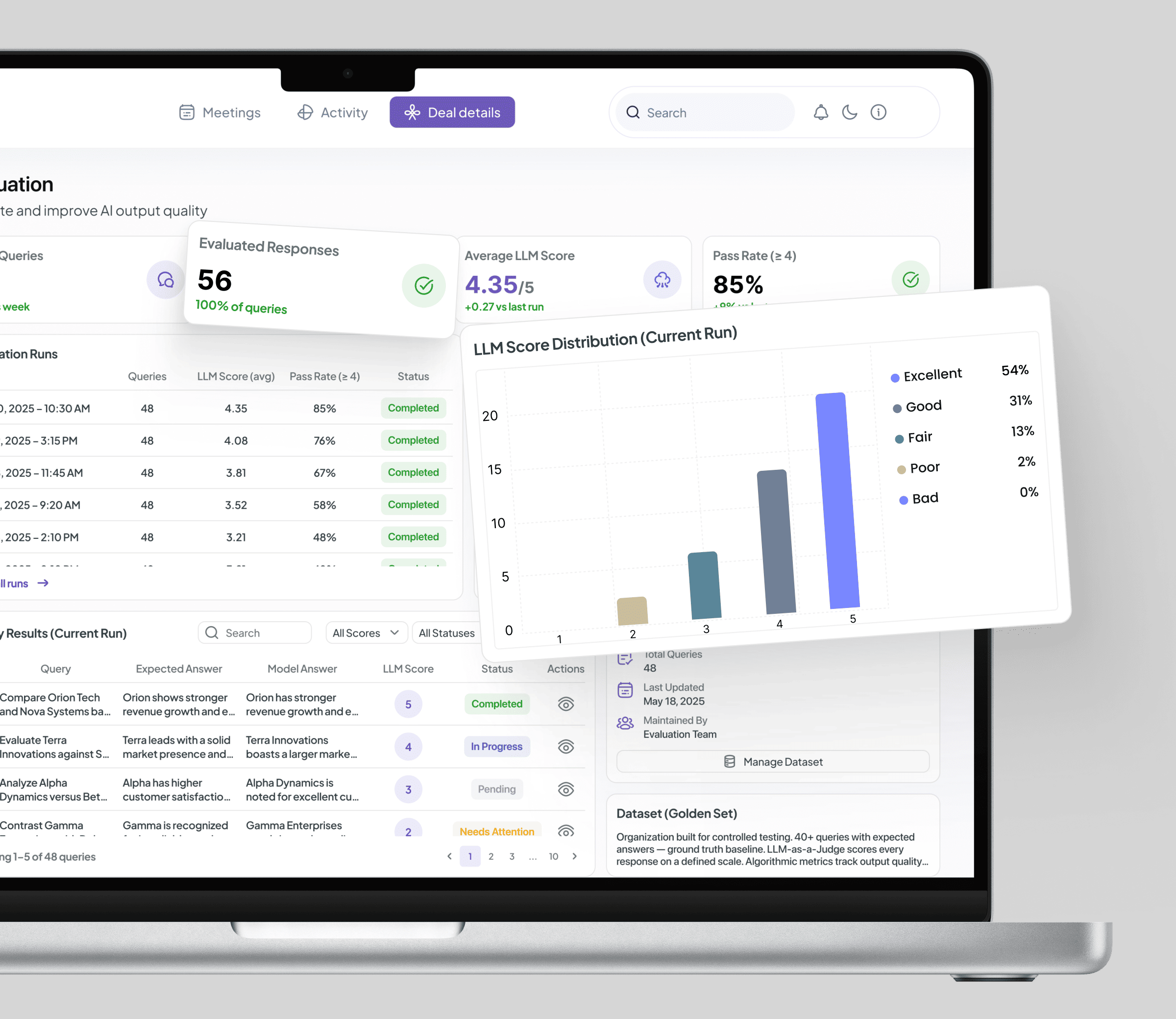
  • One LLM answers; a second LLM grades the response
  • Scores measure progress across each release iteration
  • Helps detect quality regressions before new versions ship
Release quality view with LLM score distribution and pass or fail markers per evaluation query before shipping

Key results and business value

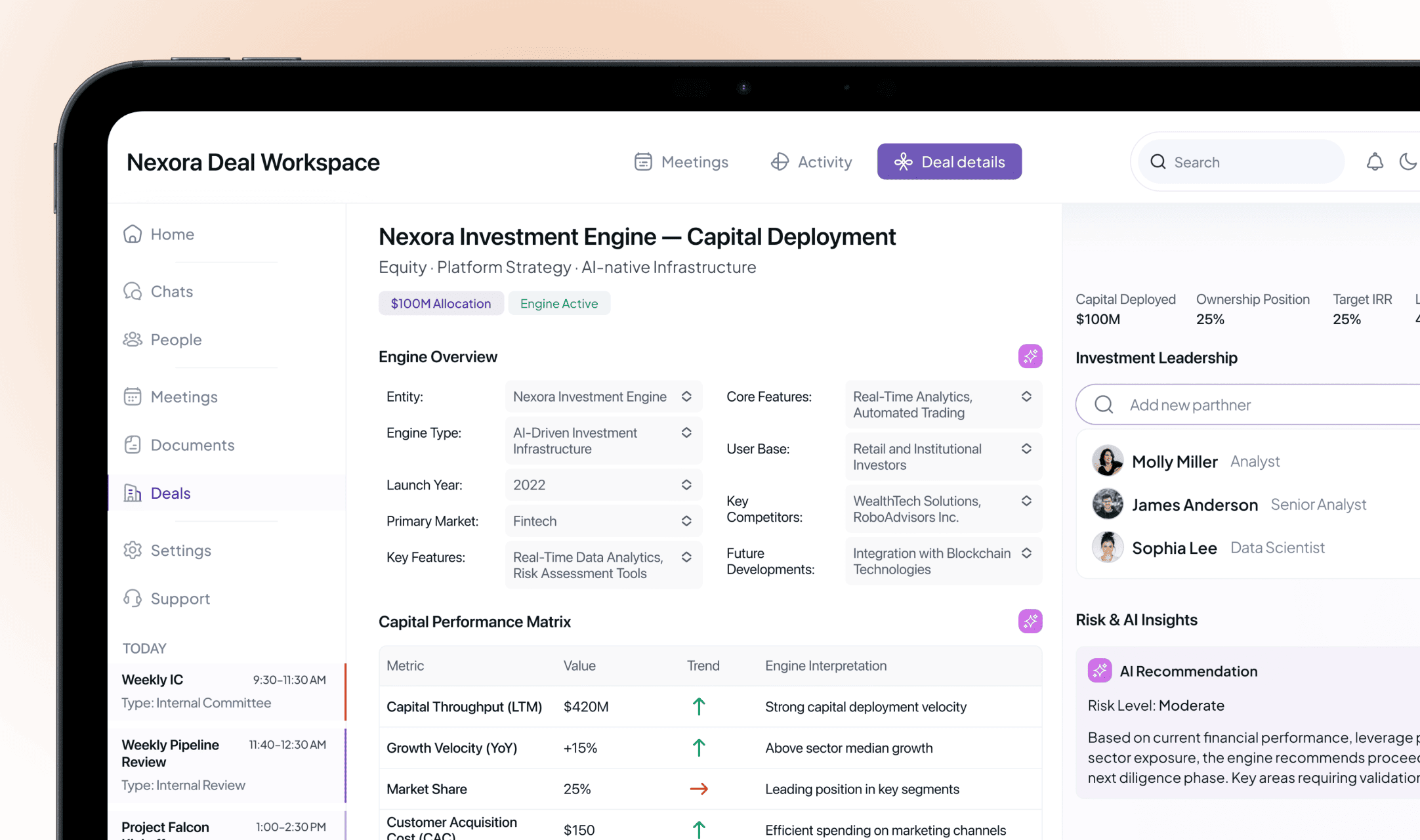
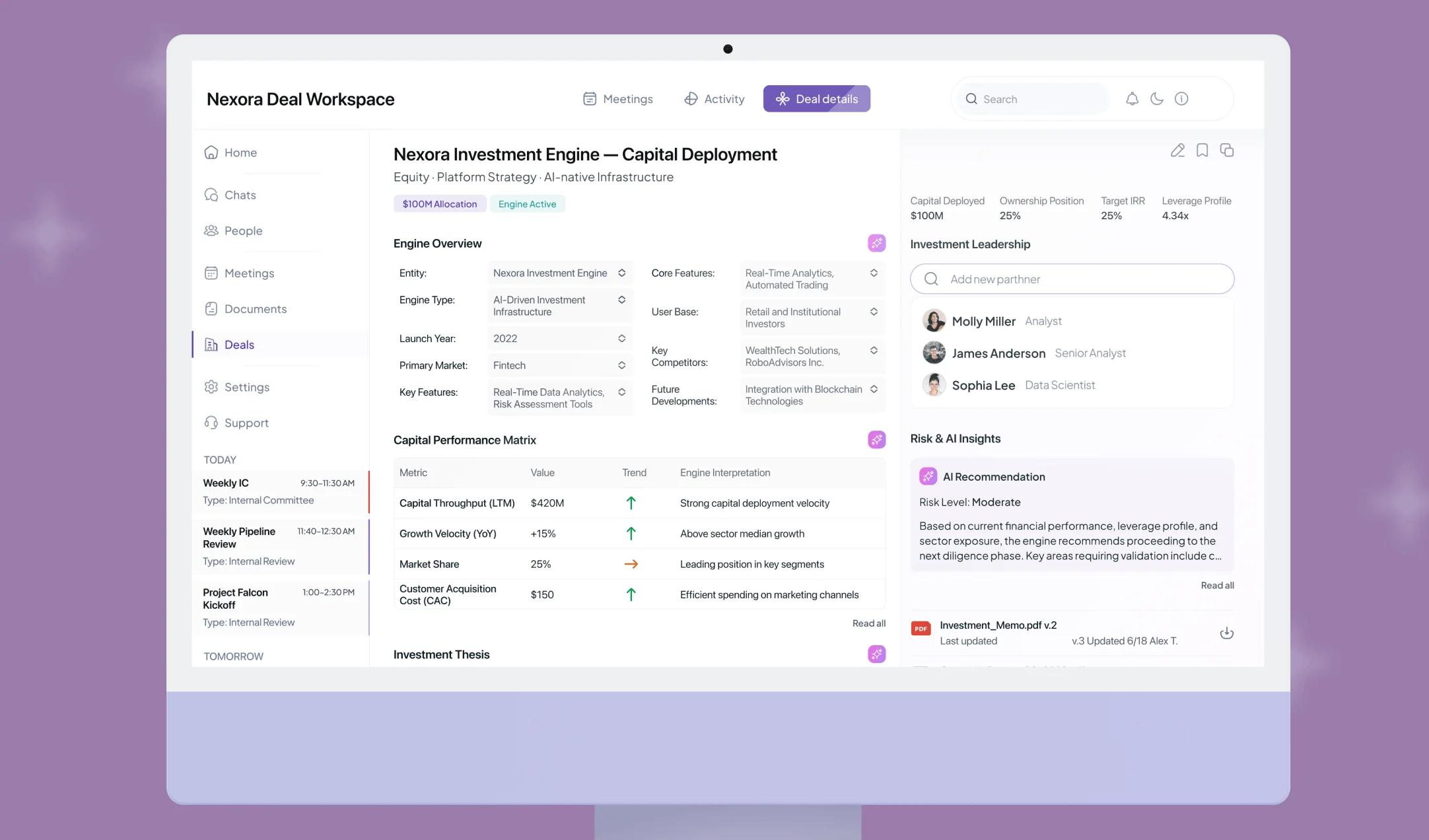
Investment CRM deal workspace showing deployed capital by company, active deals, and key contacts

Faster access to deal and company context across the CRM
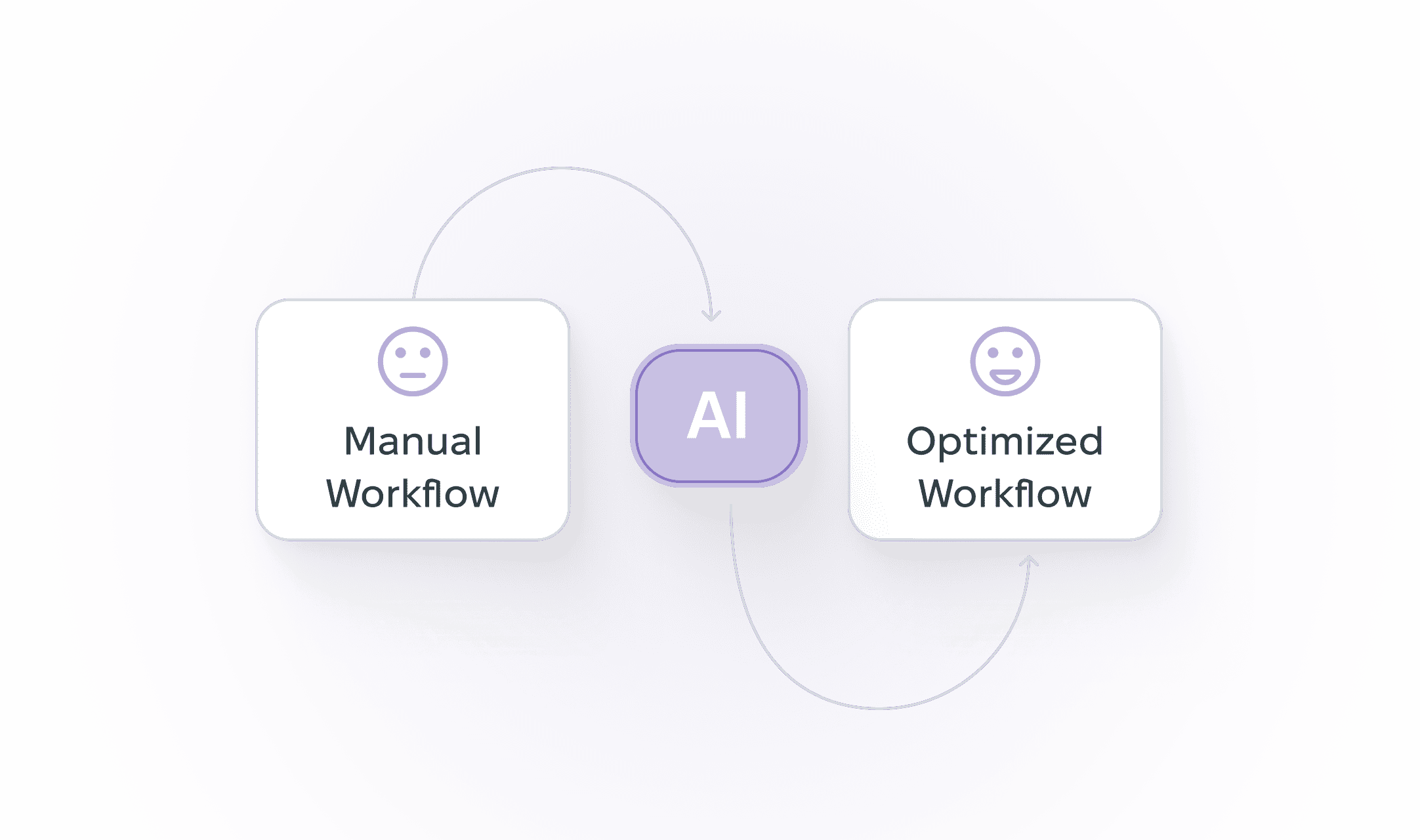
Side-by-side comparison of manual CRM research versus AI-assisted investment pipeline and deal analysis

Reduced manual effort in pipeline and investment analysis
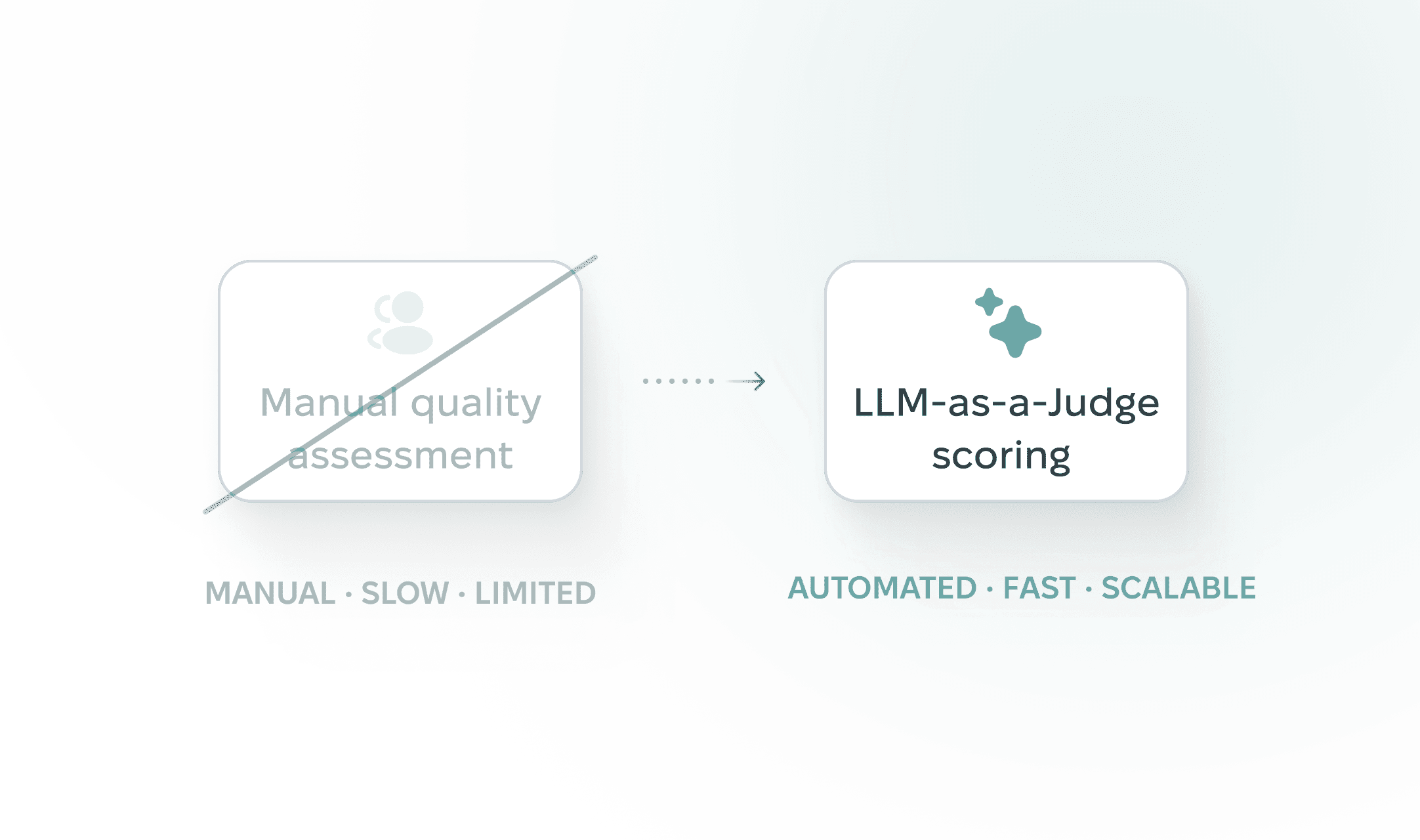
Shift from manual review of assistant answers to automated LLM-as-a-Judge scoring in the evaluation pipeline

Manual quality assessment replaced by automated LLM-as-a-Judge scoring
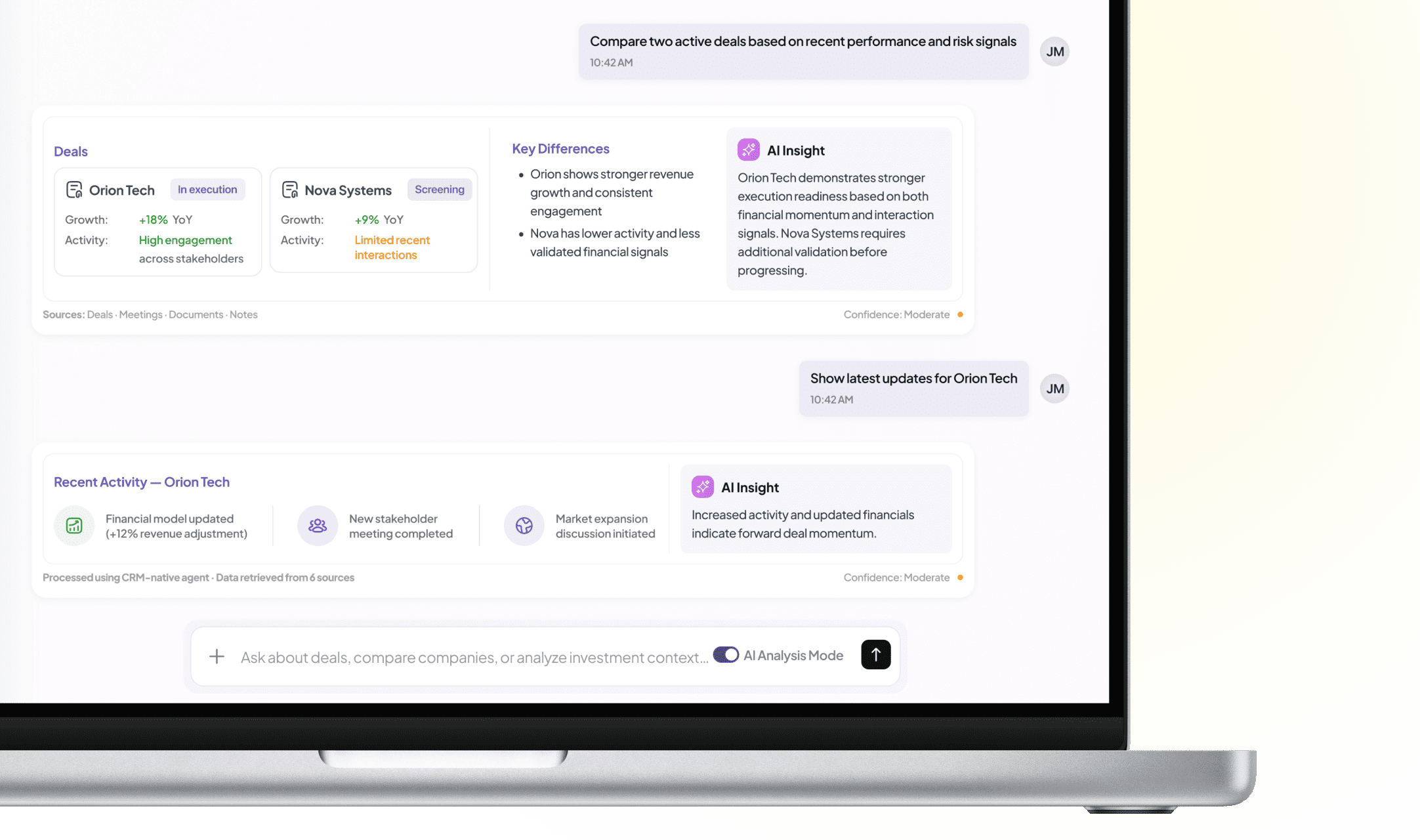
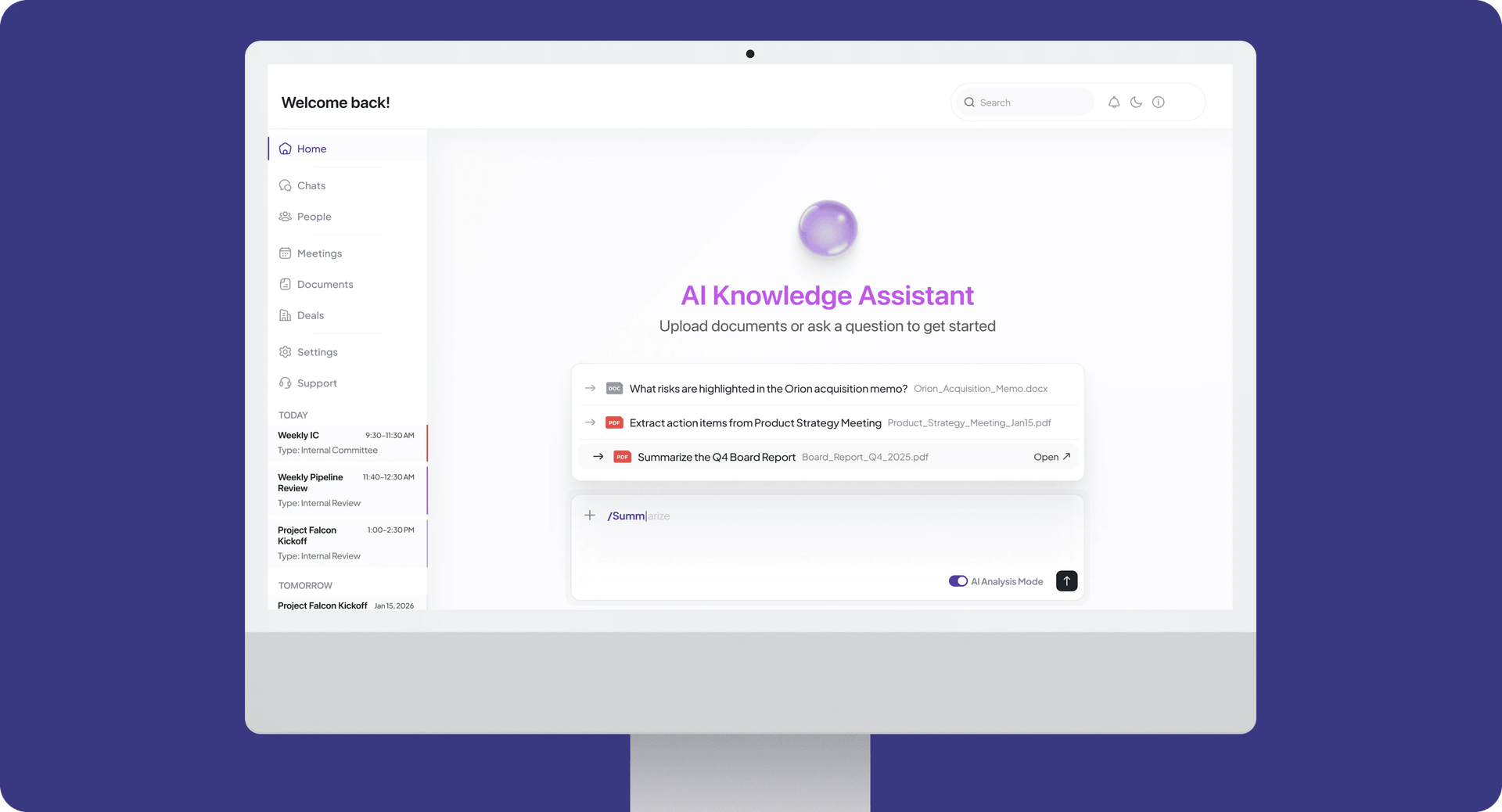
CRM-native assistant comparing opportunities with analysis mode and responses grounded in CRM records

Consistent assistant responses grounded in CRM knowledge
Features Delivered

Mobile screen of the PE AI assistant comparing two deals with key differences, insight summary, and prompt field

Key Capabilities of the AI Assistant:

  • Natural-language access across all core CRM entities
  • Faster deal and pipeline analysis on demand
  • Comparative analysis across companies and opportunities
  • Automated summarization of investment-related documents
  • Intent-based routing across tools and data sources
  • Evaluation workflow for release quality validation
Amazon Web Services logo — cloud infrastructure in the investment platform stack

AWS

Google Cloud Platform logo — cloud infrastructure in the investment platform stack

GCP

Apache Kafka logo — event streaming in the investment platform stack

Apache Kafka

PyTorch logo — machine learning framework used for the assistant

PyTorch

Hugging Face logo — NLP and model tooling in the assistant stack

Hugging Face

Apache Airflow logo — workflow orchestration in the platform stack

Airflow

GitHub logo — source control and collaboration for the project

GitHub

Docker logo — containerized deployment in the platform stack

Docker

Apache Superset logo — analytics and dashboards in the platform stack

Apache Superset

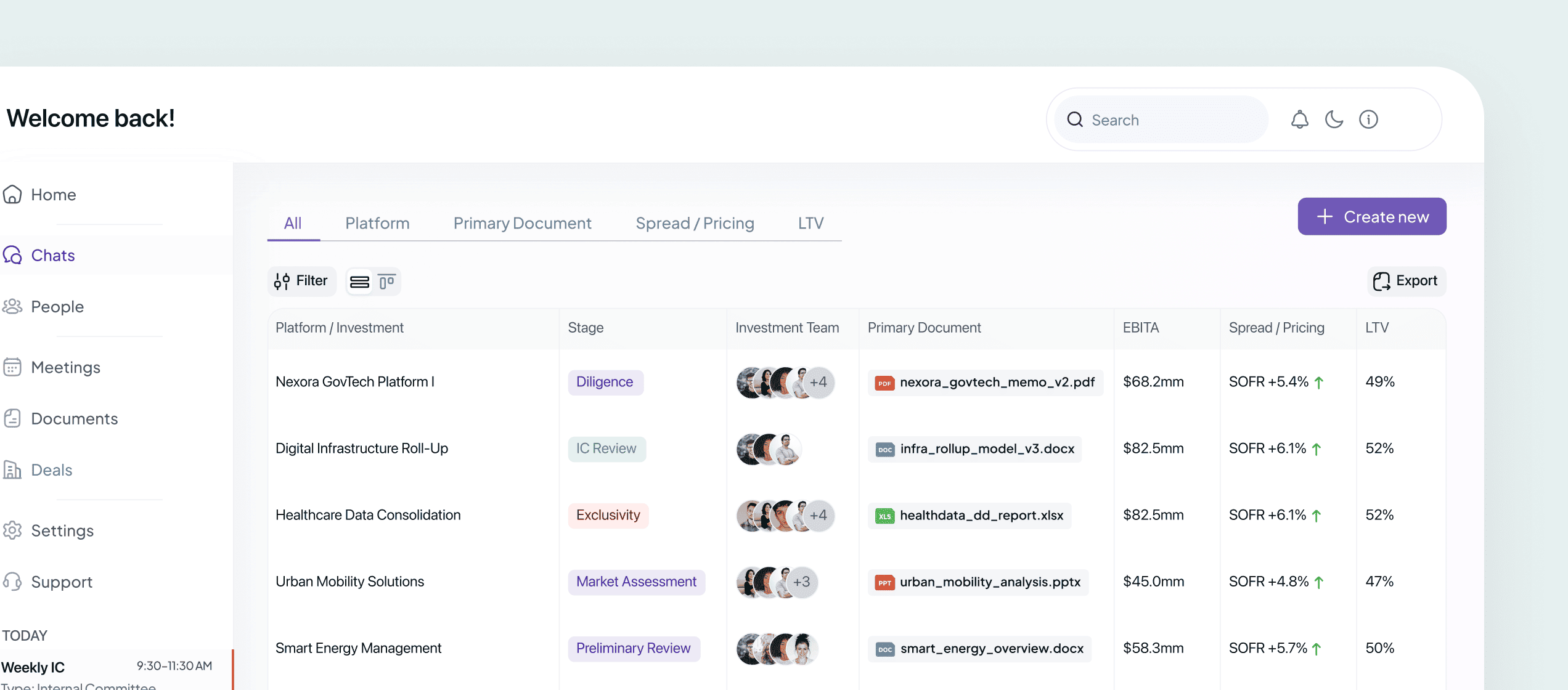
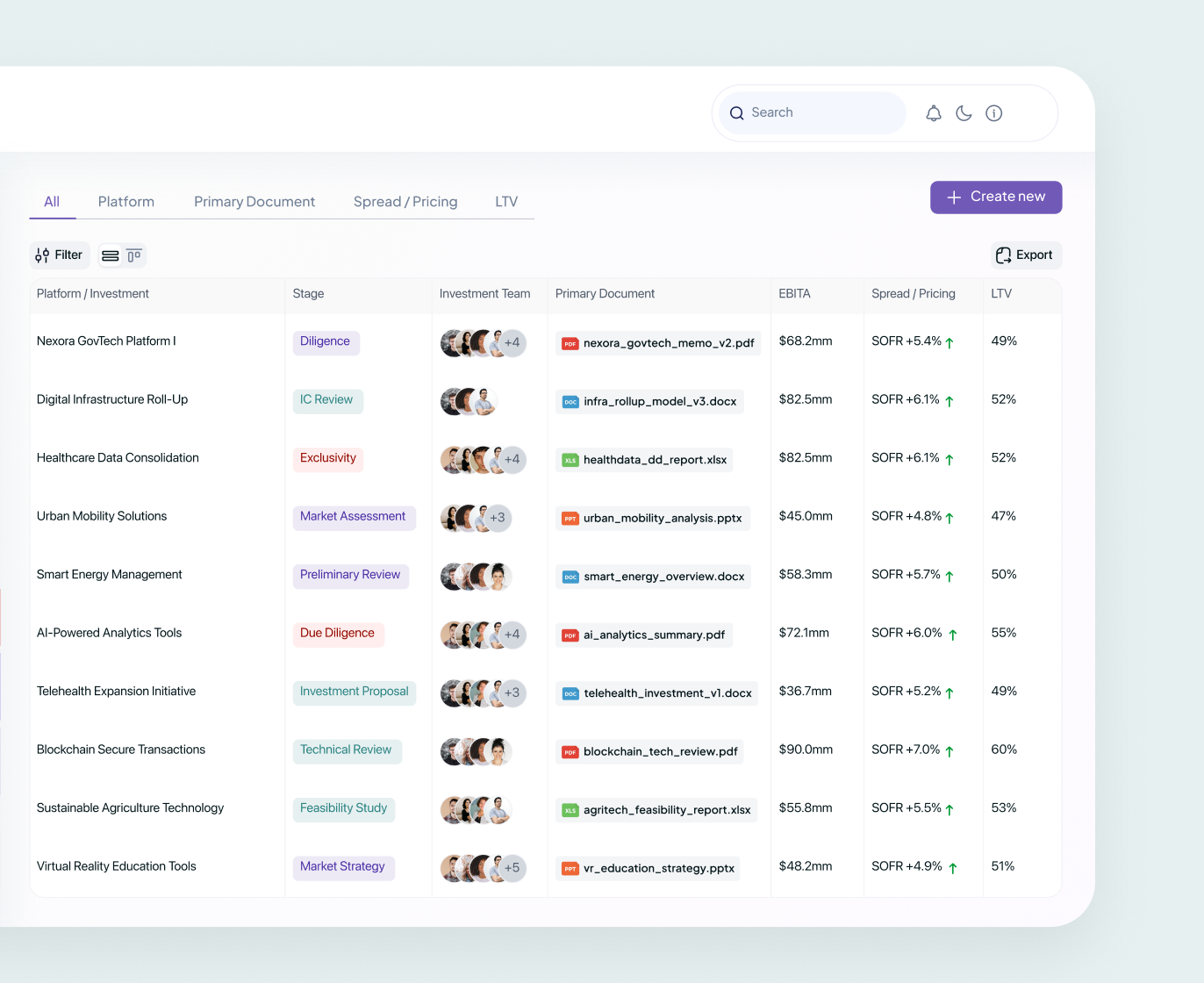
Desktop view of the investment CRM pipeline, capability list, and technology stack for the AI assistant release

Technical Highlights

Custom Agent Framework

Designed agent-based architecture with optimized tool orchestration per query type.

CRM Entity Modeling

AI trained on CRM entities, relationships, and tool logic to work with data, not just retrieve it.

RAG + Multi-Model Stack

RAG across deals, memos, and market data; the multi-model approach balances speed and accuracy.

Golden Dataset Evals

Synthetic CRM org with 40+ questions and expected answers provides a stable ground truth for every release.

LLM-as-a-Judge Pipeline

A second LLM evaluates responses on a quality scale, supplemented by algorithmic precision metrics.

Cloud Infrastructure

Deployed on AWS and GCP with Kafka for real-time data ingestion, ensuring reliability at scale.

Client Feedback

"What's really valuable here is that the assistant doesn't just answer questions - it actually helps our clients work faster. They can get to the right deal, company, and market context much more easily, without spending so much time searching through the CRM. For us, that's a serious competitive advantage, because it makes the platform more useful in everyday work. And because every release is measured against a quality baseline, we can keep improving it without breaking the parts that already work well"

Chief Technology Officer

Client

Unlock new growth opportunities

Discover how custom software with AI-powered features can help your business move faster, improve workflows, and create new competitive advantages.

Similar solutions we implemented

Related blog posts


People & processes before models & algorithms: The 70–20–10 rule for effective AI transformation
Industry newsAI

People & processes before models & algorithms: The 70–20–10 rule for effective AI transformation

Artificial intelligence has become a boardroom fixture: investments are soaring, pilots are proliferating, and the promise of transformation is everywhere. Yet as the BCG research shows, the vast majority of organisations are not realising value. Only about 26 % of companies have developed the capabilities needed to move beyond proof-of-concept and extract measurable value, and just 4 % are at the frontier of AI-driven transformation. What this tells us is that the technology itself is not the barrier. The obstacle lies in people, processes, integration, governance, and culture. Why people and processes matter more than algorithms Among the most striking findings of the report is the so-called “10-20-70” distribution of focus for successful AI transformations: approximately 10 % of effort is directed at algorithms, 20 % at technology and data, and a full 70 % on people and processes. This may seem counterintuitive in an era of hype around models like LLMs and generative AI — yet the empirical evidence speaks clearly. Companies that invest heavily in people, workflows, change management, process redesign, and the human embedding of AI outperform those that focus primarily on hard tech. Even building a team using AI is more efficient now.

Best Practices for Integrating AI into Existing Business Processes
BusinessAI

Best Practices for Integrating AI into Existing Business Processes

Integrating AI into existing business operations is one of the most powerful levers a company can pull — but it’s also one of the riskiest. Many organizations struggle not because AI is flawed, but because their approach to integration fails to respect how their business truly operates. The promise of efficiency, insight, and automation often clashes with legacy systems, culture, and technical debt. Over years of project work and observing successes and failures across industries, several patterns of strong AI integration have emerged. In this article, I outline five best practices — not superficial rules, but deep lessons that require discipline, humility, and ongoing care. These are the guardrails that help AI become a partner, not a disruption. 1. Align AI strategy with business purpose and processes

How to Train AI for Your Business
BusinessAI

How to Train AI for Your Business

Artificial intelligence is no longer a distant dream — it’s a daily tool that is transforming how companies operate. From personalizing customer experiences to predicting demand and automating processes, AI has become a vital driver of growth across industries. But here’s the catch: you can’t just “plug in” AI and expect miracles. To unlock its full potential, and to understand how to succeed in AI adoption, you need to train AI properly, with your business goals and context in mind. In this article, we’ll explore what it really takes to train AI for business, breaking the process into clear steps, highlighting the challenges, and showing why the right partner makes all the difference. Step 1: Define the problem, not the tool One of the most common mistakes in AI adoption is starting with technology instead of the problem. Businesses often ask, “Which AI model should we use?” when the better question is, “What business challenge are we solving?” Are you trying to reduce customer churn? Speed up your supply chain? Optimize sales campaigns? The clarity of your goal defines the scope of the AI solution. Without it, you risk building something impressive on paper that doesn’t move the needle in practice.