YTC LogoYTC Logo
Home
Case Studies
Blog
Menu illustration
ServicesCase StudiesHow we workAbout usCareerContactsBlogHelp Center
sales@ytc.company
sales@ytc.company
Home
Cases
Ad Analytics Platform for High-Volume Campaign Management

Ad Analytics Platform for High-Volume Campaign Management

Ad Analytics Platform for High-Volume Campaign ManagementAd Analytics Platform for High-Volume Campaign Management
AIAWSCRMDataBI

Ad Analytics Platform for High-Volume Campaign Management

AIAWSCRMDataBI

Mobihunter, a mobile marketing agency, came to us with a need to simplify campaign tracking and eliminate manual reporting across multiple advertising platforms. Our solution is a centralized analytics CRM system that aggregates campaign data, automates metric calculations, and provides instant access to performance insights, enabling teams to reduce reporting errors, eliminate spreadsheet workflows, and make faster operational decisions.

Industry

AdTech

Client

Mobihunter

Region

Hong Kong

Main challenges

Business Challenge: Manual reporting slowed decisions and caused errors

The team relied on spreadsheets to calculate campaign metrics, which created delays and frequent inaccuracies in reporting.
  • Manual data exports from multiple advertising platforms
  • High risk of human errors in formulas and calculations
  • Delayed access to performance insights for decision-making
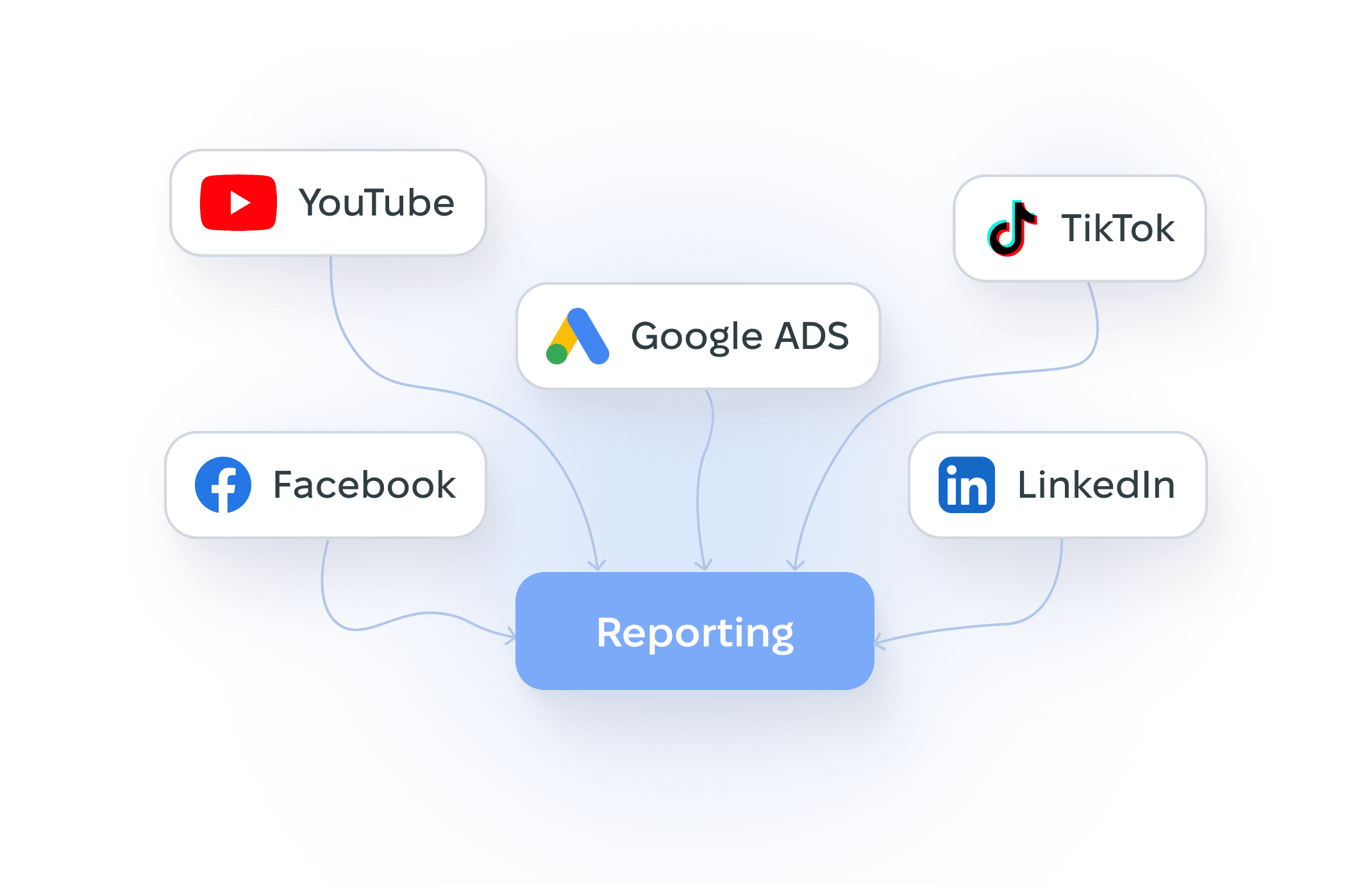
Reporting workflow connecting YouTube, TikTok, Google Ads, Facebook, and LinkedIn campaign data

Technical Challenge: Fragmented data and a lack of a unified metrics system

Campaign data existed across multiple platforms without a centralized system to calculate and visualize performance metrics.
  • No automated aggregation of multi-platform advertising data
  • Raw statistics without calculated performance metrics
  • Limited reporting capabilities in the existing system
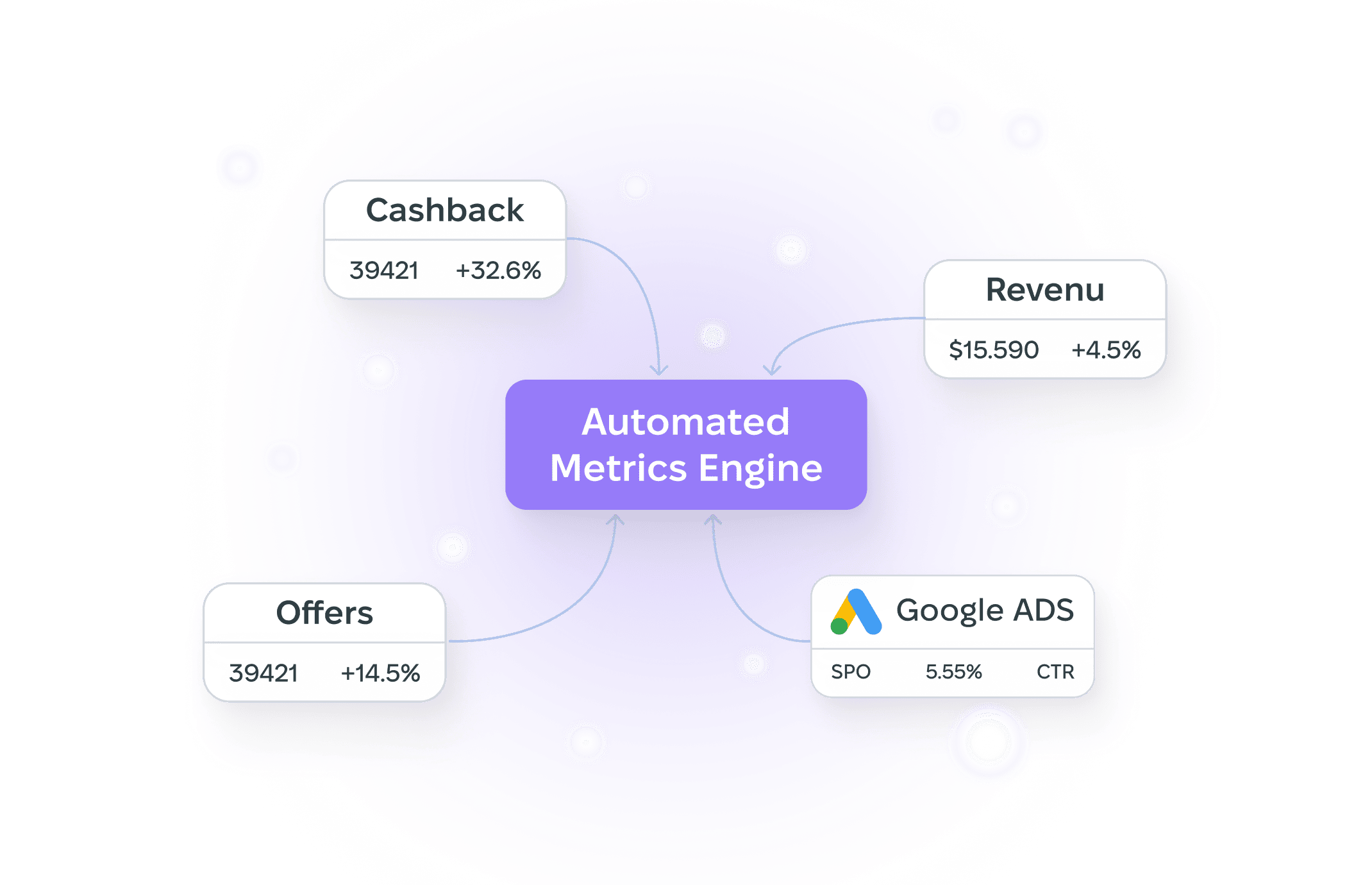
Automated metrics engine combining cashback, revenue, offers, and Google Ads performance data

Delivery Challenge: Replacing manual reporting without disrupting operations

The team relied heavily on existing spreadsheet workflows, making it challenging to introduce a new system without slowing down ongoing campaign operations.
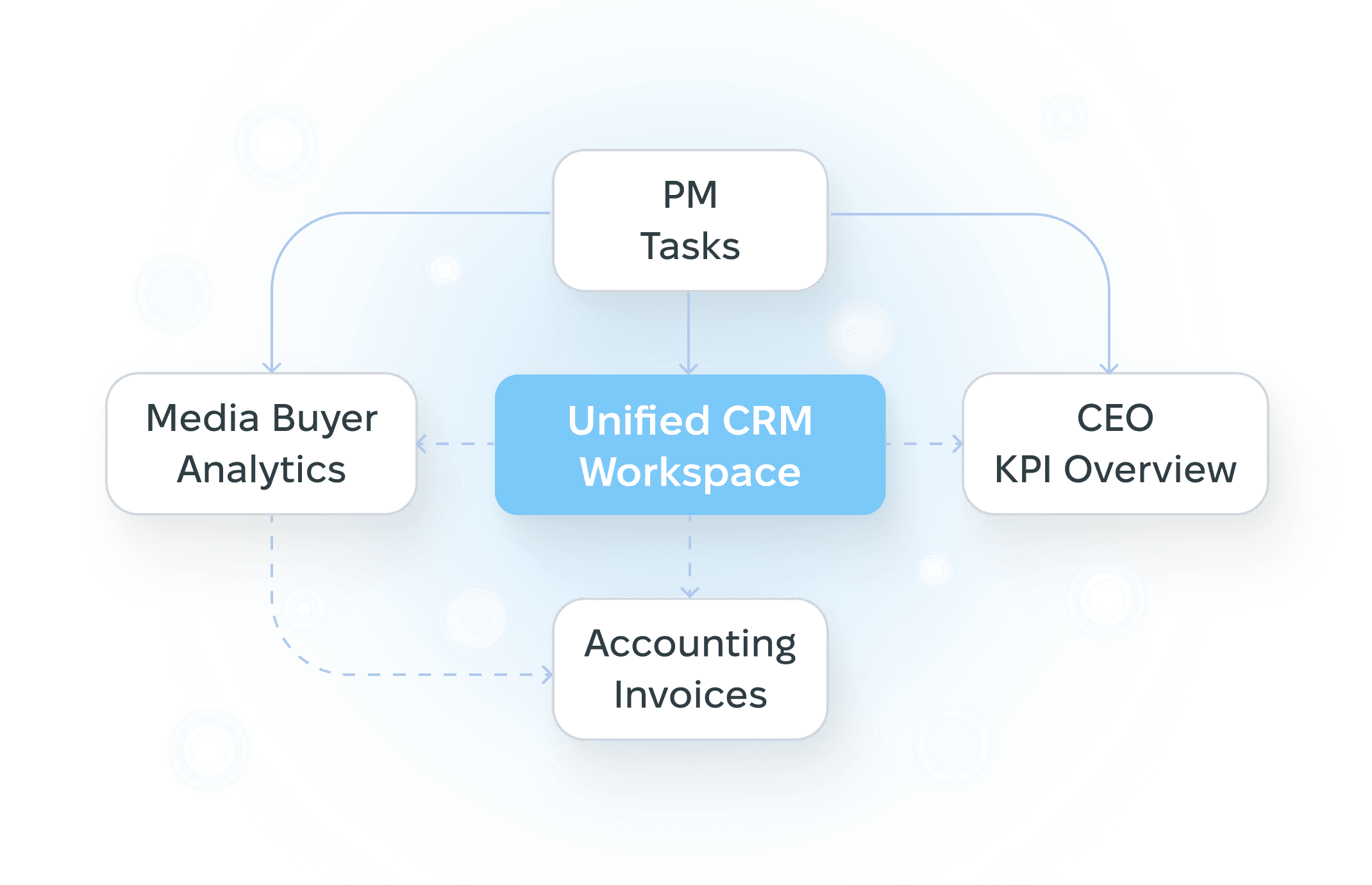
  • Existing workflows fully built around spreadsheets
  • Transition risked slowing down daily campaign operations
  • Needed parallel usage during gradual system adoption
Unified CRM workspace connecting PM tasks, media buyer analytics, CEO KPI overview, and accounting invoices

What we did

We implemented a centralized analytics CRM system that replaced fragmented workflows by aggregating campaign data automatically on a daily basis. Performance metrics became instantly accessible without manual preparation or coordination between roles. A structured campaign setup logic allowed teams to configure offers and tracking conditions once and receive consistent metrics without recalculations.

This eliminated spreadsheet dependency and reduced human errors in reporting. An automated metrics engine calculated key indicators such as install-based performance in real time. Teams gained direct access to insights, reacted to campaign changes faster, and reduced delays in decision-making across ongoing advertising operations.

$100K+per day

Advertising budget processed and analyzed across campaigns

20M+ 

Daily impressions tracked and structured into performance data

2800+ 

Campaigns managed within a unified analytics system

10+platforms

Integrated into a single operational data layer

Unified Advertising Data

We built a reporting flow that collects campaign data from key advertising channels and prepares it for analysis.

  • Aggregated campaign data from multiple advertising platforms
  • Structured raw statistics into a consistent reporting format
  • Reduced manual data preparation for marketing and operations teams

This replaced repetitive spreadsheet exports with a cleaner data flow for daily campaign reporting.
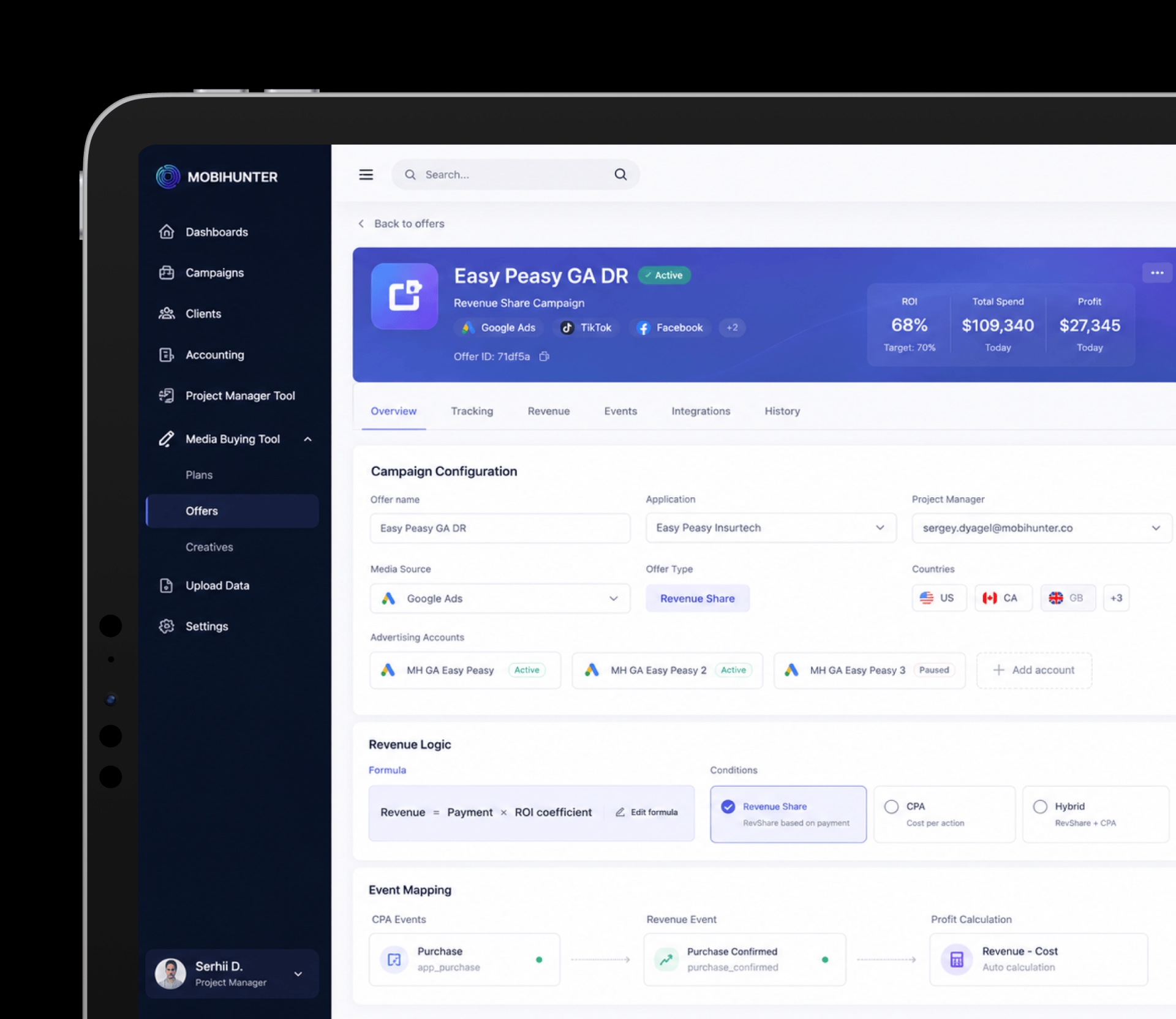
Unified advertising data workspace combining multi-platform campaign sources

Automated Metrics Engine

We created a metrics layer that calculates campaign performance indicators from raw advertising data.

  • Automated calculations for revenue, cashback, offers, CTR, and spend-related metrics
  • Unified campaign performance logic across multiple data sources
  • Minimized formula errors caused by manual spreadsheet work

The system made performance reporting more accurate, repeatable, and easier to scale across campaigns.
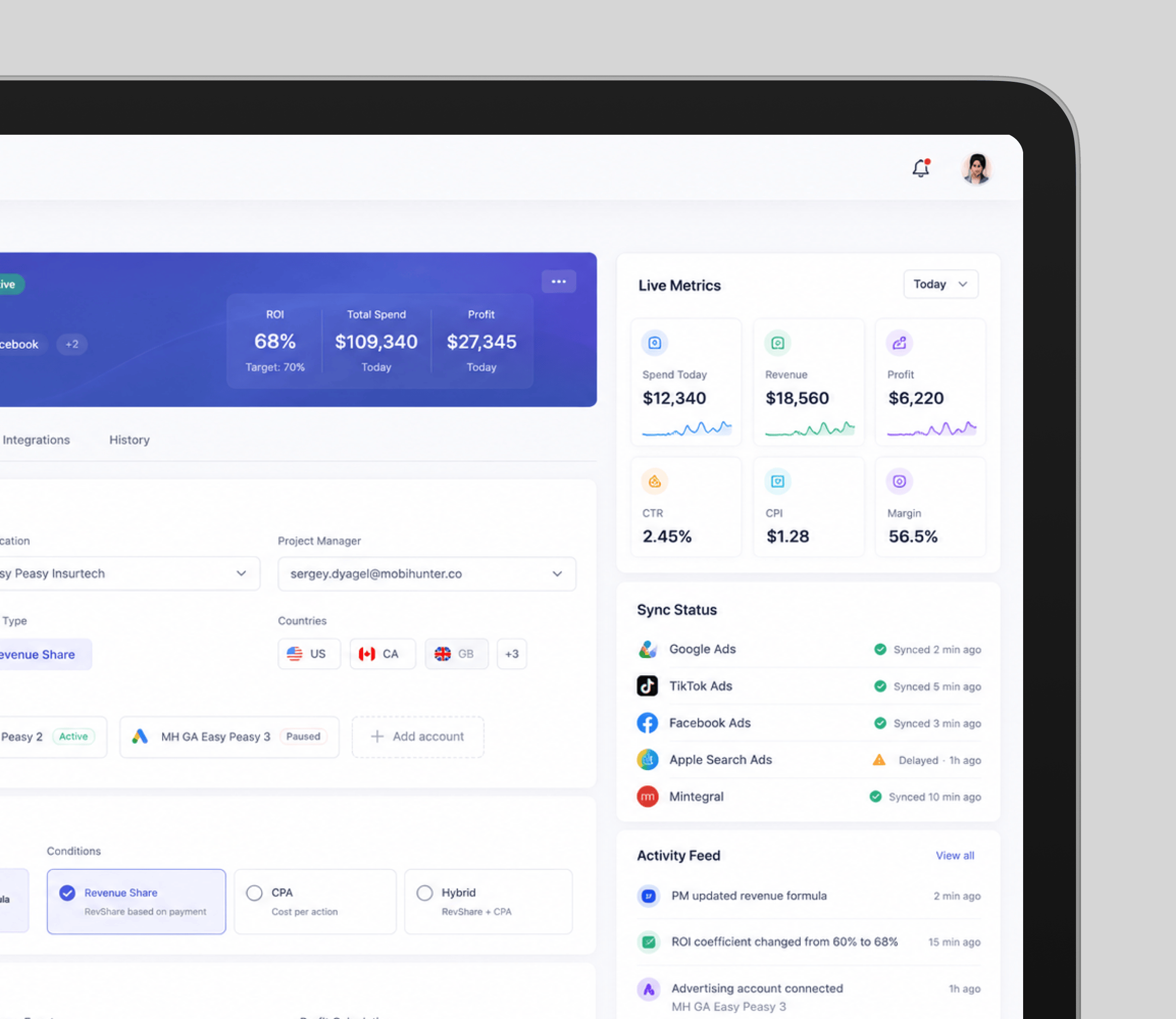
Automated metrics dashboard calculating campaign performance indicators

Campaign Management Workspace

We connected analytics, campaign tasks, KPI overview, and accounting context in one operational workspace.

  • Built a shared workspace for PM tasks, media buyer analytics, CEO KPI overview, and invoices
  • Supported a gradual transition from spreadsheets to platform-based reporting
  • Improved visibility across campaign operations and financial context

This helped stakeholders work from the same source of truth while the team adopted the new workflow gradually.
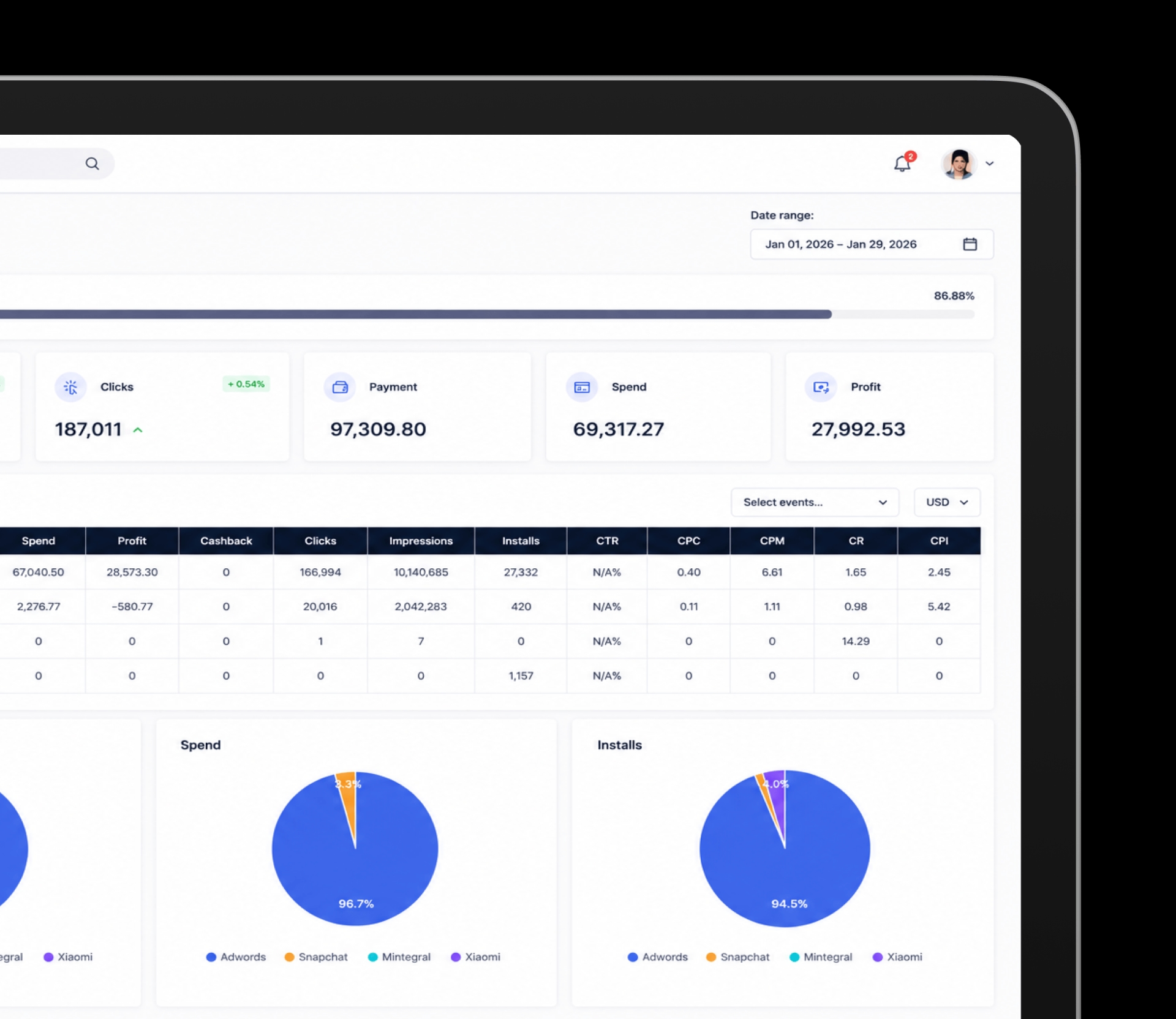
Campaign management workspace for tracking offers, performance, and campaign operations

Operations Module

We added an operations module to keep campaign workflows, financial context, and stakeholder visibility connected.

  • Connected operational tasks with campaign performance context
  • Kept invoices and accounting-related data available alongside analytics
  • Improved visibility for managers, media buyers, and finance stakeholders

This gave teams a shared operational layer for daily campaign execution and reporting.
Operations module connecting campaign tasks, reporting, and accounting workflows

Key results and business value

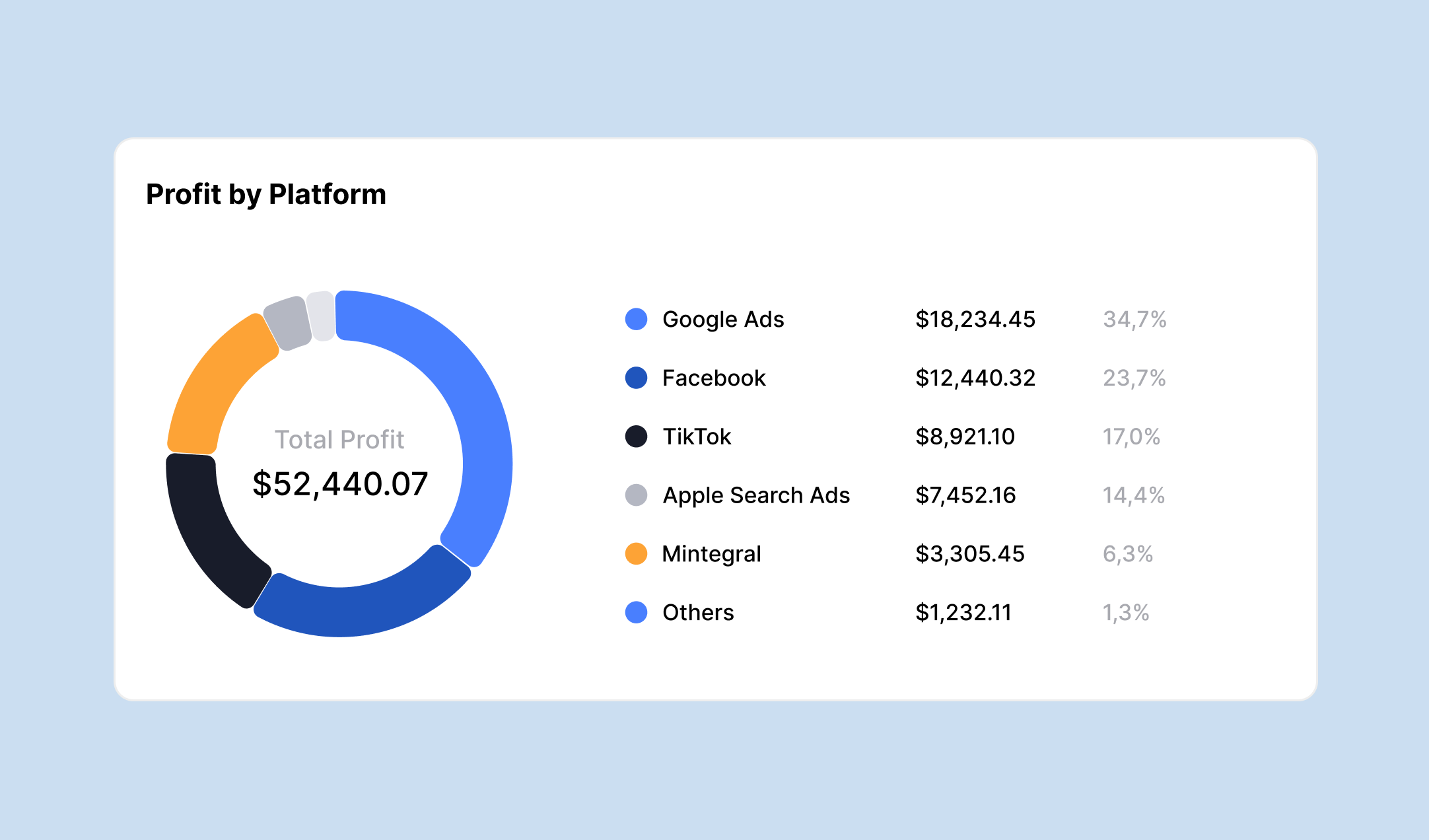
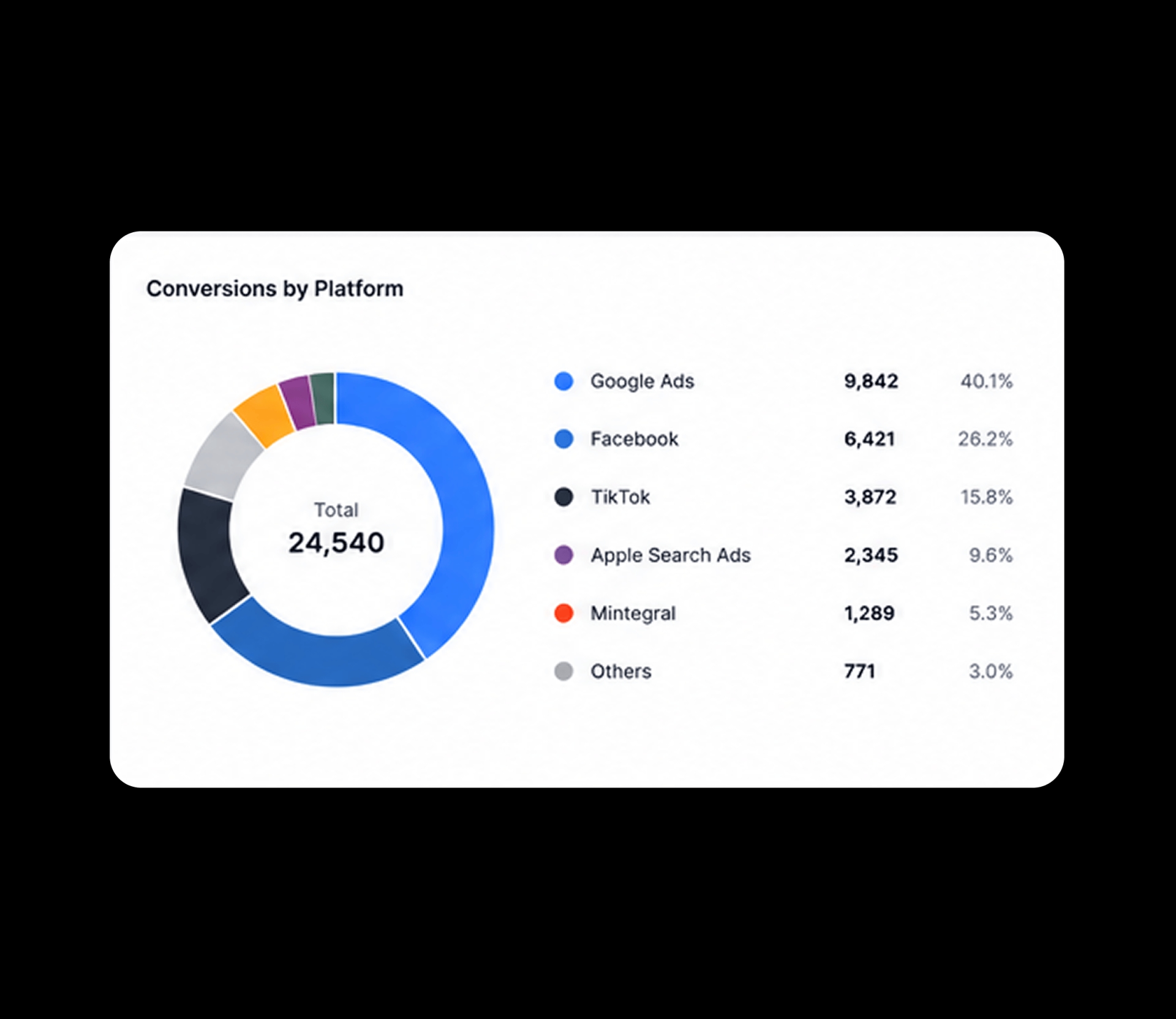
Profit by platform chart showing aggregated advertising performance data

Manual spreadsheet reporting replaced by automated data aggregation

Top offers by profit table inside a centralized analytics CRM system

Fragmented campaign data unified into a centralized analytics CRM system
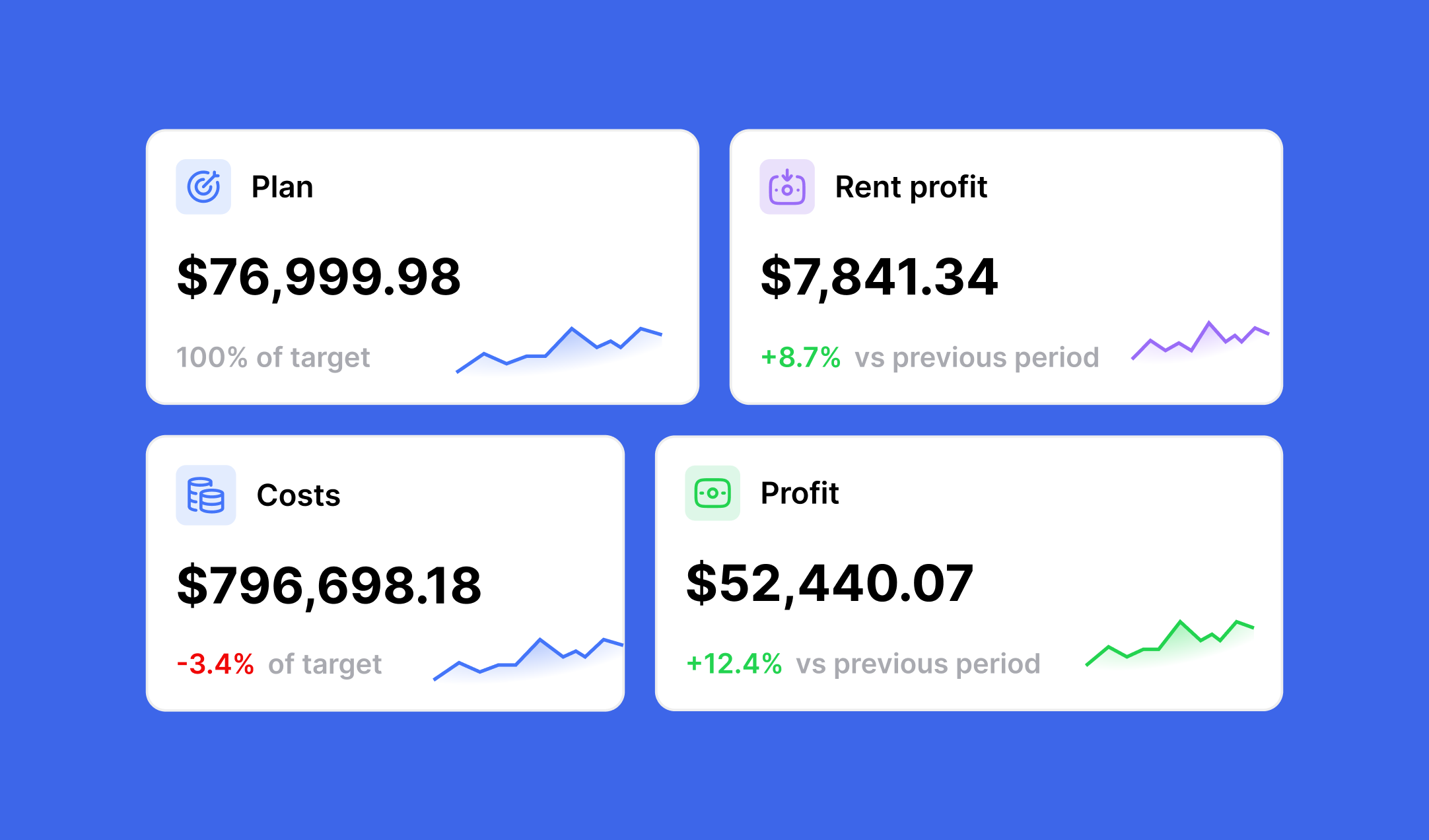
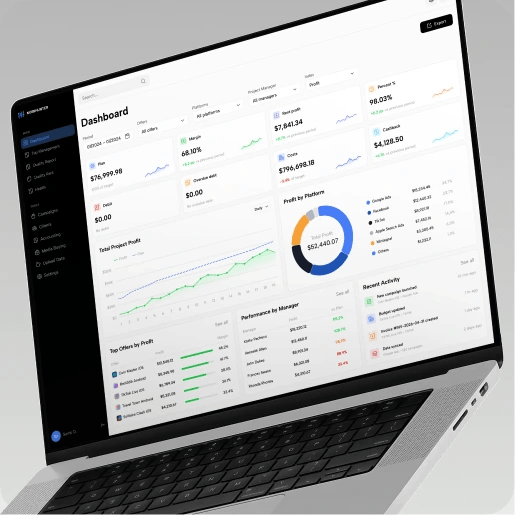
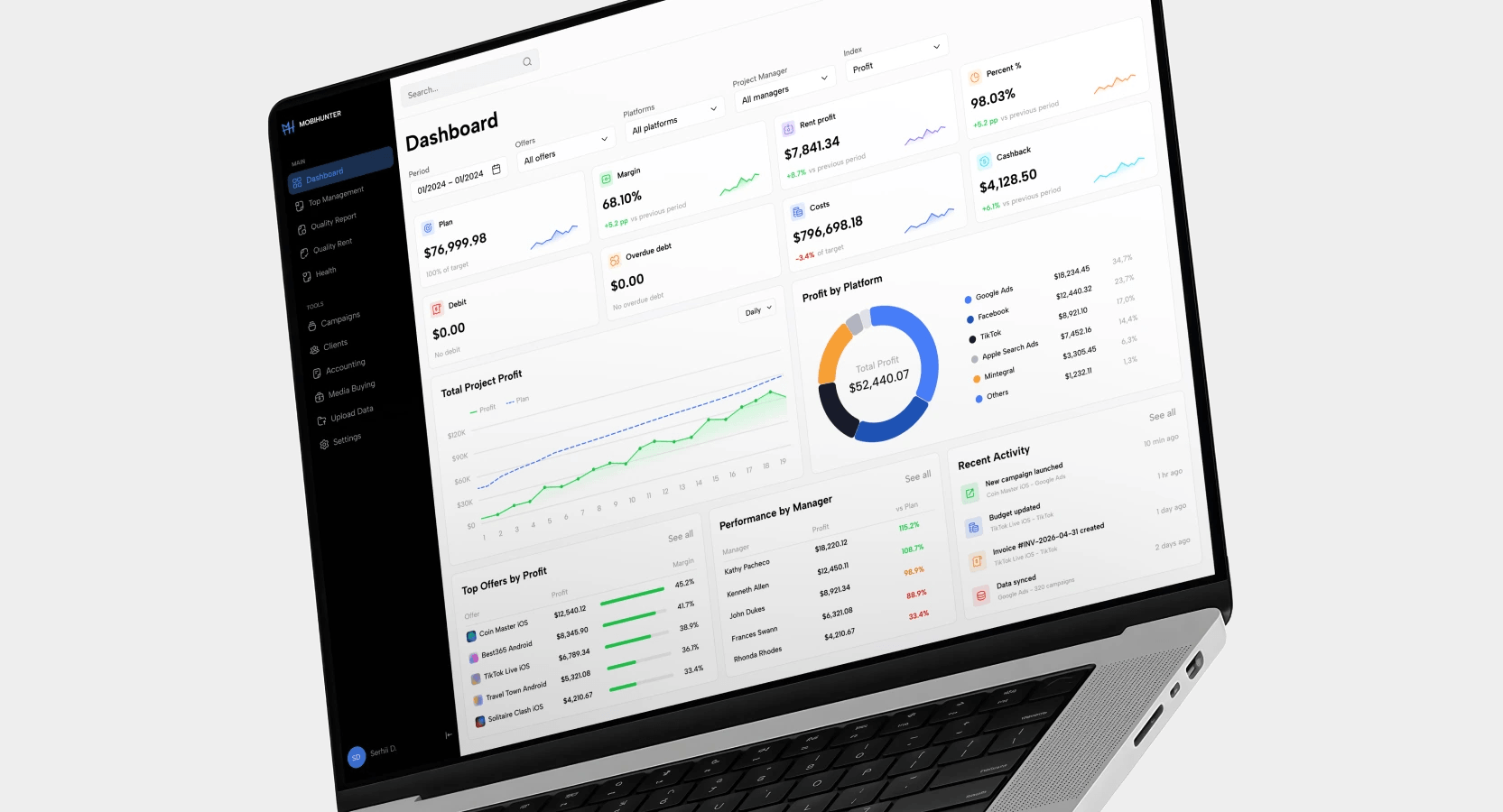
Automated performance tracking cards for plan, rent profit, costs, and profit

Manual metric calculations replaced with automated performance tracking
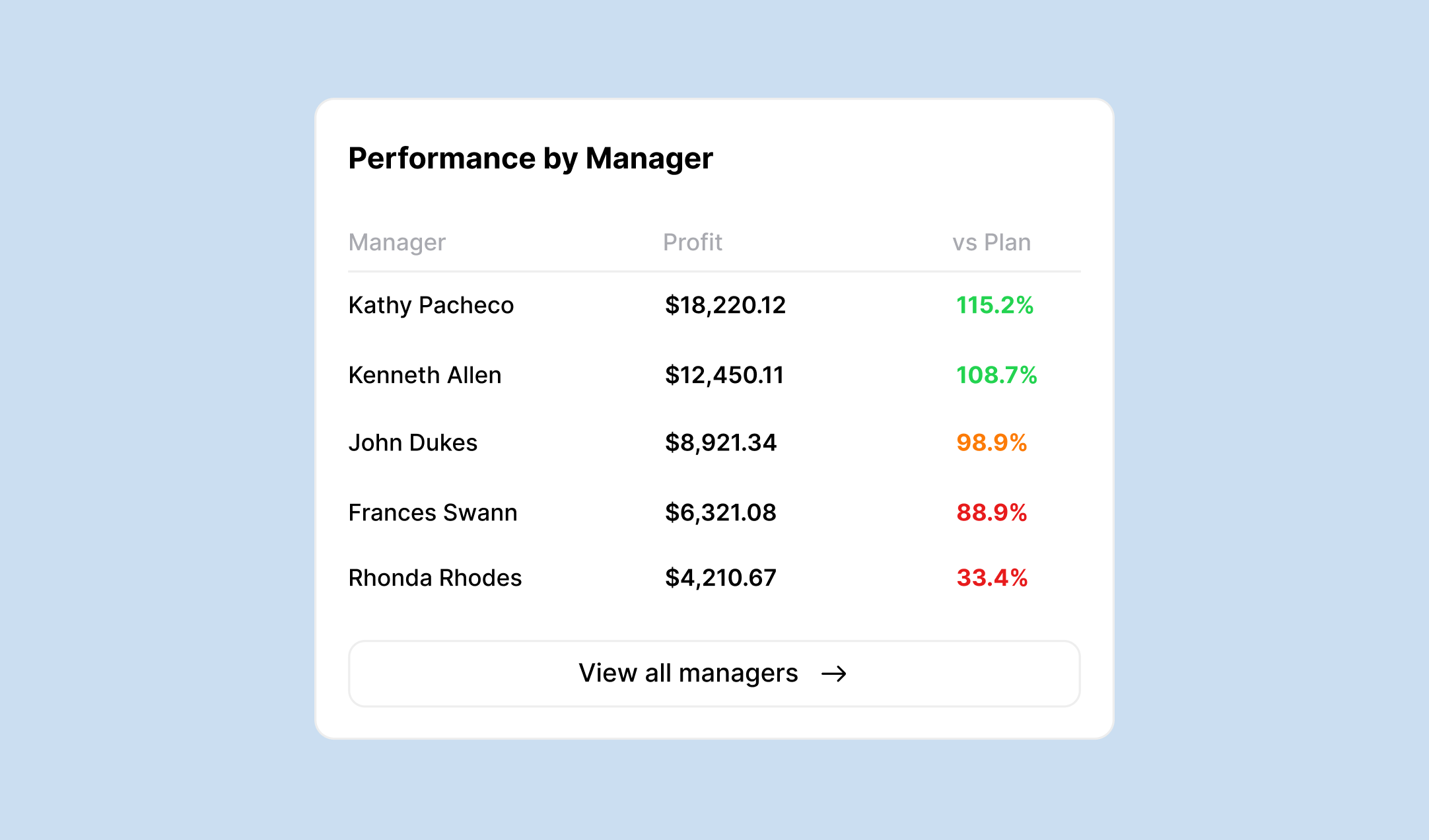
Performance by manager table showing continuous campaign monitoring data

End-of-month reporting became continuous data monitoring
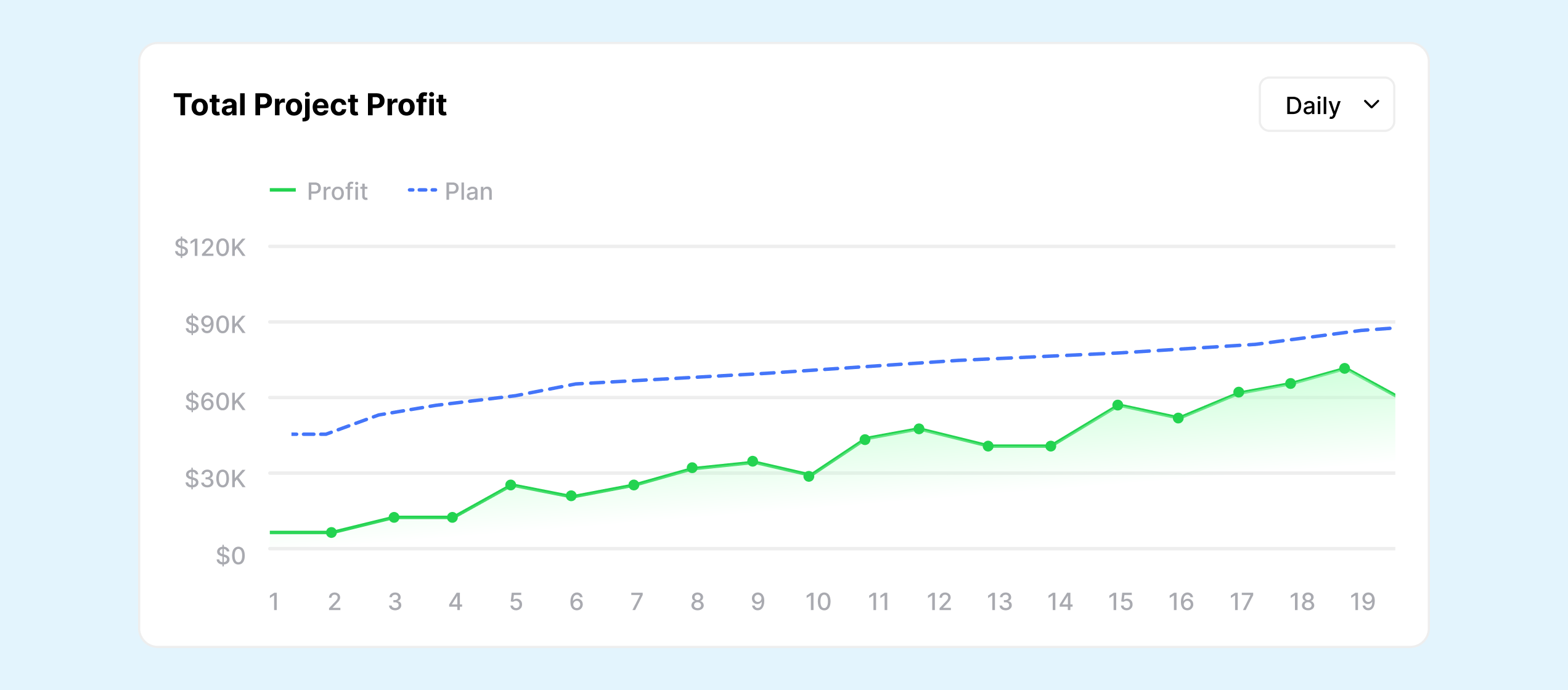
Features Delivered

Total project profit line chart comparing profit and plan over time

Key Capabilities of the Ad Analytics Platform:

  • Multi-platform campaign data aggregation and daily synchronization
  • Automated calculation of performance metrics across campaigns
  • Centralized CRM for unified campaign tracking and reporting
  • Real-time access to performance data without manual reporting
AWS logo for cloud infrastructure

AWS

Airflow logo for workflow orchestration

Airflow

Apache Superset logo for analytics dashboards

Apache Superset

PyTorch logo for data and machine learning workflows

PyTorch

React logo for the ad analytics platform frontend

React

GitHub logo for source control and collaboration

GitHub

Travis CI logo for continuous integration

Travis CI

Docker logo for containerized deployment

Docker

Ansible logo for infrastructure automation

Ansible

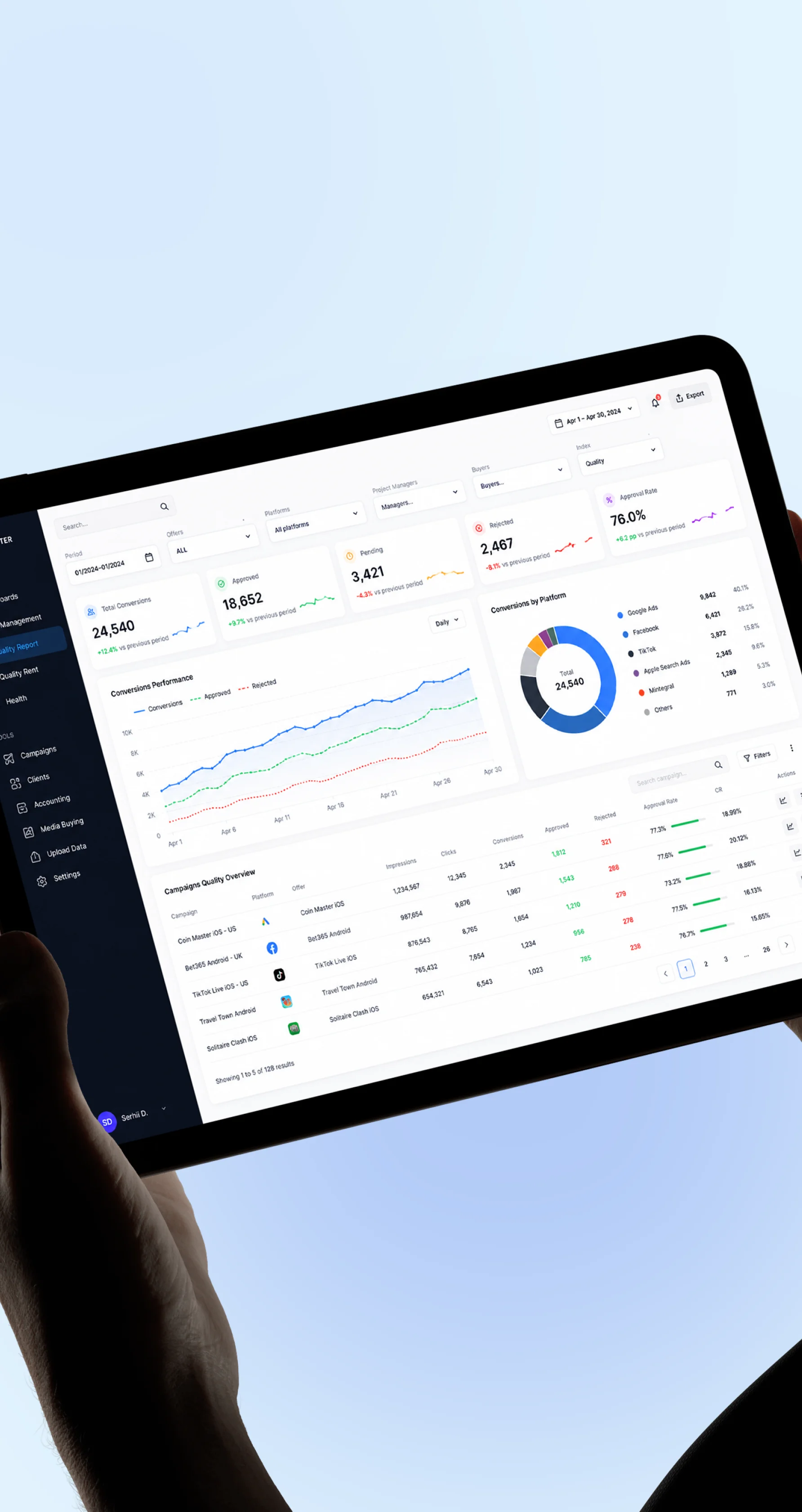
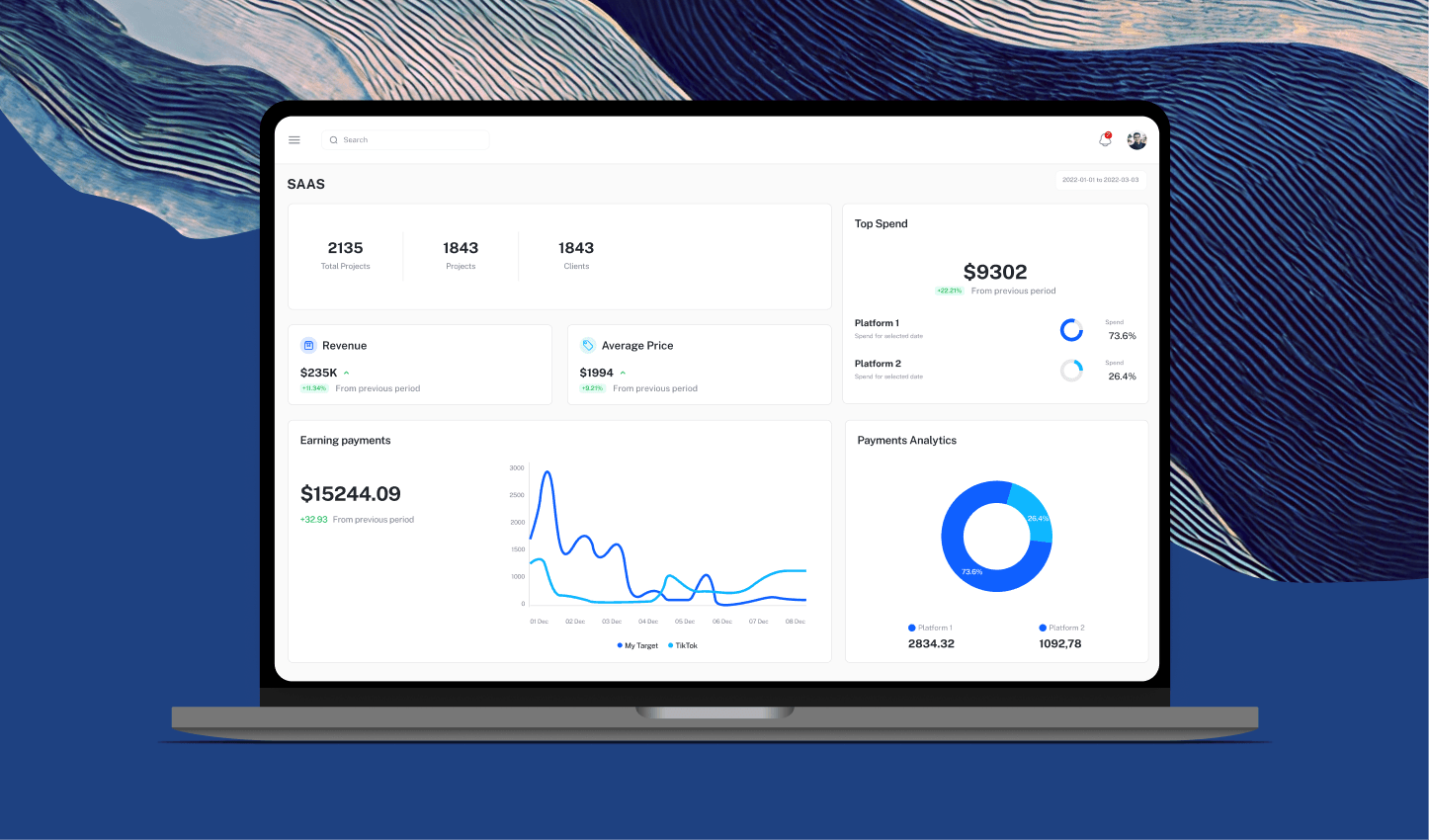
Analytics dashboard displayed on a tablet with campaign metrics and performance tables

Technical Highlights

Multi-Platform Integration

Unified data from multiple advertising platforms into one pipeline, eliminating manual exports

Automated Metrics Engine

Campaign metrics calculated automatically, removing spreadsheets and reducing errors

Role-Based Reporting

Implemented reporting views for different roles, from detailed media buyer reports to CEO dashboards

Planning & Offer Integration

Developed planning functionality integrated with client offers, aligning media buying and management

Centralized Data Storage

Implemented unified data storage to support scalable campaign tracking across thousands of campaigns

Dynamic Configuration

Developed a flexible configuration system for offers, events, and tracking rules across clients

Invoicing Automation Logic

Created backend workflows to generate invoices directly from campaign performance data

Iterative Architecture

Continuously reworked system architecture to support scaling and evolving product requirements

Multi-Platform Integration

Unified data from multiple advertising platforms into one pipeline, eliminating manual exports

Automated Metrics Engine

Campaign metrics calculated automatically, removing spreadsheets and reducing errors

Role-Based Reporting

Implemented reporting views for different roles, from detailed media buyer reports to CEO dashboards

Planning & Offer Integration

Developed planning functionality integrated with client offers, aligning media buying and management

Centralized Data Storage

Implemented unified data storage to support scalable campaign tracking across thousands of campaigns

Dynamic Configuration

Developed a flexible configuration system for offers, events, and tracking rules across clients

Invoicing Automation Logic

Created backend workflows to generate invoices directly from campaign performance data

Iterative Architecture

Continuously reworked system architecture to support scaling and evolving product requirements

Client Feedback

"The biggest pain for us was reporting. We used to spend hours just pulling data into spreadsheets, and now everything is there instantly. There are no more errors from calculations, no more manual work we had to double-check all the time. What used to take days at the end of the month now takes just minutes. Overall, it gave us way more control and speed in how we run large-scale advertising campaigns"

Yulia K, Marketing Manager

Yulia K

Marketing Manager

Unlock new growth opportunities

Discover how custom software with AI-powered features can help your business move faster, improve workflows, and create new competitive advantages.

Similar solutions we implemented

Creatives Platform for Mobile Ads Company
  • UI/UX
  • Data
  • AWS
  • Web app

Creatives Platform for Mobile Ads Company

Client Portal for Mobile  Ads Company
  • Data
  • AWS
  • Web app

Client Portal for Mobile Ads Company

See all case studies

Related blog posts

‌
Why only one in four companies extracts real value from AI — and how yours can be the exception
Industry newsAIBusiness

Why only one in four companies extracts real value from AI — and how yours can be the exception

The excitement around artificial intelligence has shown no signs of slowing. Every week brings new headlines of breakthroughs, new models, and new tools. Yet despite this hype, value remains elusive. According to BCG’s extensive research, while upwards of 98 % of companies are experimenting with AI, only around 26 % have developed the capabilities to move beyond proof of concept and generate measurable value. Even more striking: just 4 % of companies have achieved the kind of systematic AI-driven transformation that the consulting firm classifies as leadership. These numbers aren’t just statistics — they’re a warning. Investing in AI without the right foundation is like building on sand: visible, exciting, but unstable. Yet the story does not end in caution. The same report outlines what the top companies are doing differently — and offers a blueprint for how your business in finance, travel, media, coaching, or news/disinformation can break through the barrier from “pilot” to “productised value.” At YTC, we’ve absorbed those lessons into our deep and wise AI consulting through T-Shaped research approach and solution-development methodology. Let’s walk through the critical differentiators and how you can apply them. 1. Focus on core processes and value generation, not just experiments
‌
How to Train AI for Your Business
BusinessAI

How to Train AI for Your Business

Artificial intelligence is no longer a distant dream — it’s a daily tool that is transforming how companies operate. From personalizing customer experiences to predicting demand and automating processes, AI has become a vital driver of growth across industries. But here’s the catch: you can’t just “plug in” AI and expect miracles. To unlock its full potential, and to understand how to succeed in AI adoption, you need to train AI properly, with your business goals and context in mind. In this article, we’ll explore what it really takes to train AI for business, breaking the process into clear steps, highlighting the challenges, and showing why the right partner makes all the difference. Step 1: Define the problem, not the tool One of the most common mistakes in AI adoption is starting with technology instead of the problem. Businesses often ask, “Which AI model should we use?” when the better question is, “What business challenge are we solving?” Are you trying to reduce customer churn? Speed up your supply chain? Optimize sales campaigns? The clarity of your goal defines the scope of the AI solution. Without it, you risk building something impressive on paper that doesn’t move the needle in practice.
‌
How does AI improve user experience
AIUI/UX

How does AI improve user experience

In today’s market, user experience isn’t a “nice to have” — it’s a deciding factor in whether people stay loyal to your brand or switch to your competitors. And the expectations are higher than ever. Customers want speed, personalization, and seamless interaction across every channel. This is where AI moves from buzzword to business advantage. It doesn’t just automate tasks — it transforms how people feel when they interact with your product or service. And a better experience usually means better retention, higher spend, and stronger brand advocacy. Let’s break down three key ways AI can take your user experience to the next level.
Read all posts

Related blog posts

Read all
‌
Why only one in four companies extracts real value from AI — and how yours can be the exception
Industry newsAIBusiness

Why only one in four companies extracts real value from AI — and how yours can be the exception

The excitement around artificial intelligence has shown no signs of slowing. Every week brings new headlines of breakthroughs, new models, and new tools. Yet despite this hype, value remains elusive. According to BCG’s extensive research, while upwards of 98 % of companies are experimenting with AI, only around 26 % have developed the capabilities to move beyond proof of concept and generate measurable value. Even more striking: just 4 % of companies have achieved the kind of systematic AI-driven transformation that the consulting firm classifies as leadership. These numbers aren’t just statistics — they’re a warning. Investing in AI without the right foundation is like building on sand: visible, exciting, but unstable. Yet the story does not end in caution. The same report outlines what the top companies are doing differently — and offers a blueprint for how your business in finance, travel, media, coaching, or news/disinformation can break through the barrier from “pilot” to “productised value.” At YTC, we’ve absorbed those lessons into our deep and wise AI consulting through T-Shaped research approach and solution-development methodology. Let’s walk through the critical differentiators and how you can apply them. 1. Focus on core processes and value generation, not just experiments
‌
How to Train AI for Your Business
BusinessAI

How to Train AI for Your Business

Artificial intelligence is no longer a distant dream — it’s a daily tool that is transforming how companies operate. From personalizing customer experiences to predicting demand and automating processes, AI has become a vital driver of growth across industries. But here’s the catch: you can’t just “plug in” AI and expect miracles. To unlock its full potential, and to understand how to succeed in AI adoption, you need to train AI properly, with your business goals and context in mind. In this article, we’ll explore what it really takes to train AI for business, breaking the process into clear steps, highlighting the challenges, and showing why the right partner makes all the difference. Step 1: Define the problem, not the tool One of the most common mistakes in AI adoption is starting with technology instead of the problem. Businesses often ask, “Which AI model should we use?” when the better question is, “What business challenge are we solving?” Are you trying to reduce customer churn? Speed up your supply chain? Optimize sales campaigns? The clarity of your goal defines the scope of the AI solution. Without it, you risk building something impressive on paper that doesn’t move the needle in practice.
‌
How does AI improve user experience
AIUI/UX

How does AI improve user experience

In today’s market, user experience isn’t a “nice to have” — it’s a deciding factor in whether people stay loyal to your brand or switch to your competitors. And the expectations are higher than ever. Customers want speed, personalization, and seamless interaction across every channel. This is where AI moves from buzzword to business advantage. It doesn’t just automate tasks — it transforms how people feel when they interact with your product or service. And a better experience usually means better retention, higher spend, and stronger brand advocacy. Let’s break down three key ways AI can take your user experience to the next level.

Related blog posts

‌
Why only one in four companies extracts real value from AI — and how yours can be the exception
Industry newsAIBusiness

Why only one in four companies extracts real value from AI — and how yours can be the exception

The excitement around artificial intelligence has shown no signs of slowing. Every week brings new headlines of breakthroughs, new models, and new tools. Yet despite this hype, value remains elusive. According to BCG’s extensive research, while upwards of 98 % of companies are experimenting with AI, only around 26 % have developed the capabilities to move beyond proof of concept and generate measurable value. Even more striking: just 4 % of companies have achieved the kind of systematic AI-driven transformation that the consulting firm classifies as leadership. These numbers aren’t just statistics — they’re a warning. Investing in AI without the right foundation is like building on sand: visible, exciting, but unstable. Yet the story does not end in caution. The same report outlines what the top companies are doing differently — and offers a blueprint for how your business in finance, travel, media, coaching, or news/disinformation can break through the barrier from “pilot” to “productised value.” At YTC, we’ve absorbed those lessons into our deep and wise AI consulting through T-Shaped research approach and solution-development methodology. Let’s walk through the critical differentiators and how you can apply them. 1. Focus on core processes and value generation, not just experiments
‌
How to Train AI for Your Business
BusinessAI

How to Train AI for Your Business

Artificial intelligence is no longer a distant dream — it’s a daily tool that is transforming how companies operate. From personalizing customer experiences to predicting demand and automating processes, AI has become a vital driver of growth across industries. But here’s the catch: you can’t just “plug in” AI and expect miracles. To unlock its full potential, and to understand how to succeed in AI adoption, you need to train AI properly, with your business goals and context in mind. In this article, we’ll explore what it really takes to train AI for business, breaking the process into clear steps, highlighting the challenges, and showing why the right partner makes all the difference. Step 1: Define the problem, not the tool One of the most common mistakes in AI adoption is starting with technology instead of the problem. Businesses often ask, “Which AI model should we use?” when the better question is, “What business challenge are we solving?” Are you trying to reduce customer churn? Speed up your supply chain? Optimize sales campaigns? The clarity of your goal defines the scope of the AI solution. Without it, you risk building something impressive on paper that doesn’t move the needle in practice.
‌
How does AI improve user experience
AIUI/UX

How does AI improve user experience

In today’s market, user experience isn’t a “nice to have” — it’s a deciding factor in whether people stay loyal to your brand or switch to your competitors. And the expectations are higher than ever. Customers want speed, personalization, and seamless interaction across every channel. This is where AI moves from buzzword to business advantage. It doesn’t just automate tasks — it transforms how people feel when they interact with your product or service. And a better experience usually means better retention, higher spend, and stronger brand advocacy. Let’s break down three key ways AI can take your user experience to the next level.
Read all posts
Logo YTC

Your Technical Companion

Your Technical Companion. All rights reserved. 2026

Contact Us

sales@ytc.company

Industries

AdvertisingMedia & newsRetail & logisticsEducationAutomations

Services

AI DevelopmentSoftware DevelopmentProduct DevelopmentData EngineeringDesignAI Consulting

Company

Case StudiesAbout usHelp centerCareer

Contact Us

sales@ytc.company

© 2026, YTC - Your Technical Companion All Rights Reserved